
Angkor Wat
앙코르 와트
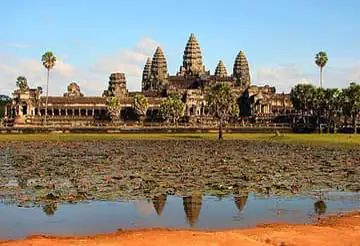
Angkor Wat is a huge stone temple near the town of Siem Reap in Cambodia. It was built in the 12th century for King Suryavarman II of the Khmer Empire, which once ruled much of mainland Southeast Asia. The complex covers about 162 hectares, and it is often described as the largest religious monument in the world.
See it on the 3D globe →At a glance
- Country
- Cambodia
- Location
- Siem Reap, Cambodia
- Built
- 1150
- Height
- 65 m
- Type
- Religious building
Quick answers
Where is Angkor Wat?
Angkor Wat is in Siem Reap, Cambodia.
When was Angkor Wat built?
Angkor Wat was built in 1150.
How tall is Angkor Wat?
Angkor Wat is about 65 m tall.
The Khmer Empire's vast temple complex, the largest religious monument in the world and on Cambodia's flag.
The temple was first dedicated to the Hindu god Vishnu. From the late 13th century it slowly became a Buddhist temple, and monks still worship there today. Angkor Wat means so much to Cambodians that a picture of it has been on the national flag since the first version of the flag in 1863. Together with the other temples of Angkor, it became a UNESCO World Heritage Site in 1992.
A mountain of the gods made of stone
Angkor Wat was designed as a model of the universe. Its five towers stand for the five peaks of Mount Meru, the mountain at the centre of the world in Hindu stories, and the central tower rises about 65 metres. The wide moat around the temple is often explained as the ocean that surrounds that mountain. The moat is about 190 to 200 metres wide and more than 5 km around. Unusually, the temple faces west instead of east like most Khmer temples, a direction linked with Vishnu.
How it was built
Builders used somewhere between five and ten million sandstone blocks, some weighing up to about 1.5 tonnes. Most of the stone came from Mount Kulen, roughly 40 km away, and historians think it was floated to the site along canals. The walls are covered in carvings. The outer gallery alone is lined with stone pictures of battles, royal parades and myths, including the famous Churning of the Ocean of Milk, where gods and demons pull on a giant serpent. More than 1,700 carved female spirits called devatas decorate the walls.
Forgotten and found again
After the Khmer capital moved away, Angkor Wat was never fully abandoned, because Buddhist monks kept using it. Still, much of the area around it was swallowed by forest. A Portuguese monk wrote about it in 1586, and the French naturalist Henri Mouhot made it famous in Europe after his visit around 1860. Today it is Cambodia's best-known sight, visited by more than two million people in a normal year.
Fun facts
- It was built as a Hindu temple to the god Vishnu and later became Buddhist.
- Angkor Wat has appeared on Cambodia's flag since the very first version in 1863.
- Its five towers are meant to look like the five peaks of Mount Meru, home of the Hindu gods.
- The moat around the temple is about as wide as two football pitches laid end to end.
- Unlike most temples nearby, Angkor Wat faces west, toward the setting sun.
- Some of its sandstone blocks were floated from quarries about 40 km away.
On the globe
The model shows the Khmer Empire's vast temple complex. Look for its tower-topped centre, the same outline that appears on Cambodia's flag.
Quiz time
Which is taller: Angkor Wat or Bayon?
Show the answer
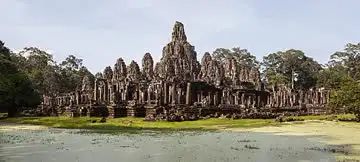
Angkor Wat. (65 m vs 43 m) Bayon →
Nearby on the globe



Sources
Updated: 2026-10-13