
Chad: landmarks, animals & facts for kids
1 landmark · 1 animal
Chad on My Earth Toy, the free 3D toy globe for kids: 1 landmark, 1 animal. Here you can see its flag, capital and size, then fly to every place on the globe.
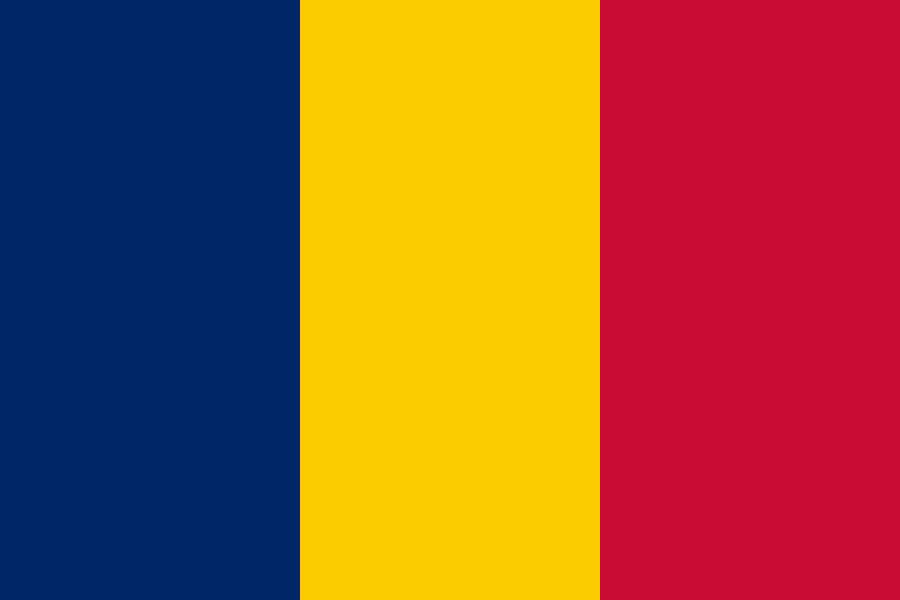
Three equal vertical stripes of dark blue, yellow and red, with blue next to the pole.
Read about this flag →Chad at a glance
- Capital
- N'Djamena
- Continent
- Africa
- Area
- 1,284,000 km²
- Population
- 20.3 million
Chad is a large, landlocked country in north-central Africa. It stretches from the sands and mountains of the Sahara in the north to green savannas in the south. Its capital is N'Djamena, and about 20 million people live there. Chad takes its name from Lake Chad, and it is known for spectacular desert rock formations, desert lakes and its rare wildlife.
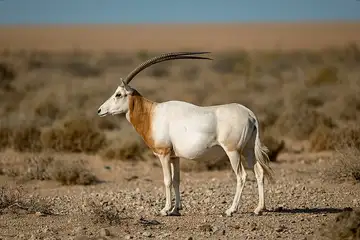
On My Earth Toy you can see the Aloba Arch in the Ennedi Plateau, one of the tallest natural rock arches in the world, rising about 120 metres high. You can also spot the scimitar oryx, a desert antelope with long, curved horns.
Geography and nature
The north is part of the Sahara, with the volcanic Tibesti Mountains; Emi Koussi is the highest peak in the whole Sahara. In the northeast, the Ennedi Plateau is full of sandstone arches, pillars and canyons, and the Lakes of Ounianga are a chain of desert lakes; both are UNESCO World Heritage Sites. The south gets more rain and has savanna and farmland. Zakouma National Park protects elephants, giraffes and lions.
People, languages and culture
Chad has more than 200 ethnic groups and over 100 languages. Arabic and French are the official languages. Islam is practised mostly in the north and centre, and Christianity mostly in the south. Many people in the north and east are herders who move with their camels, cattle and goats to find water and grass. Millet and sorghum are important foods, often made into a thick porridge eaten with sauces.
History in a nutshell
Chad has some of the oldest traces of human relatives: a skull nicknamed Toumaï, about 7 million years old, was found here in 2001. Around Lake Chad, powerful states such as the Kanem–Bornu Empire grew rich from trade across the Sahara for many centuries. France colonised the region in the early 1900s. Chad became independent on 11 August 1960. Since then it has had long periods of conflict and political change.
Fun facts
- Lake Chad has shrunk dramatically since the 1960s because of droughts and water use.
- The scimitar oryx was declared extinct in the wild in 2000, and herds have since been released back into Chad.
- Rock paintings in the Ennedi show cattle, giraffes and people from when the Sahara was greener.
- Chad is the fifth-largest country in Africa.
Famous landmarks in Chad
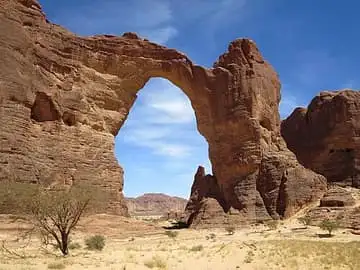
Aloba Arch
Chad · Africa
A colossal sandstone arch about 120 metres high in the Ennedi Plateau of the Sahara, one of the largest natural arches in the world.
Animals in Chad
Questions
What is the capital of Chad?
The capital of Chad is N'Djamena.
Which continent is Chad in?
Chad is in Africa.
How big is Chad?
Chad covers about 1,284,000 km².
How many people live in Chad?
About 20.3 million people live in Chad.
What are the most famous landmarks in Chad?
On My Earth Toy's free 3D globe, the landmark from Chad is Aloba Arch, with a photo and quick facts.
Which animals can you find in Chad on My Earth Toy?
On the globe you can find Scimitar oryx in Chad.
Sources
Updated: 2026-10-30