
Scimitar oryx
시미터오릭스
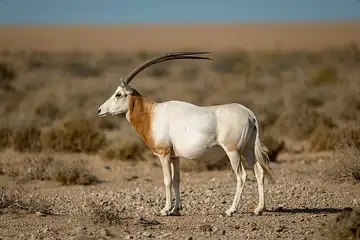
The scimitar-horned oryx is a white antelope with a chestnut neck and long, backward-curving horns. It was declared extinct in the wild in 2000, but captive-bred herds have since been reintroduced in Chad.
See it on the 3D globe →At a glance
- Class
- Mammals
- Lives in
- Sahel, south of the Sahara (Chad)
- Diet
- Plant eater (herbivore)
- Weight
- about 150 kg
- Conservation status
- Endangered (IUCN EN)
- Habitat
- deserts, grasslands
Quick answers
Where does the Scimitar oryx live?
It lives in deserts, grasslands. On the globe you can find it near Sahel, south of the Sahara (Chad).
How big is the Scimitar oryx?
It grows to about 150 kg.
What does the Scimitar oryx eat?
Its diet: plant eater (herbivore).
Is the Scimitar oryx endangered?
It is listed as Endangered (IUCN EN).
The scimitar oryx is a white antelope with a chestnut neck and long, backward-curving horns shaped like a scimitar sword. It once lived across North Africa and parts of West and Central Africa. It is adapted to harsh desert and can survive for months without drinking water, getting most of its moisture from plants.
The species was declared extinct in the wild in 2000, mostly because of hunting for its horns and a drier climate. In 2016, a reintroduction programme began, and a small herd now lives wild in Chad. In 2023 the IUCN moved it up to endangered, a real conservation success.
Built for the desert
The scimitar oryx grazes grass, hay, leaves and fruit, and is mostly active in the evening and sometimes at night. Its horns can grow longer than a metre, and adults often weigh over 200 kilograms. It lives in herds. Females have a single calf after about 300 days, and the animal lives around 18 years. It was the emblem of the ancient Egyptian Oryx nome, and today it is the symbol of the Sahara Conservation Fund.
Back from the brink
After it vanished from the wild, scimitar oryxes survived in captivity, in special reserves in Tunisia, Morocco and Senegal, and on private ranches in Texas. Animals bred there were released in Chad, where the first small herd has been rebuilt. The decline began as the climate changed in the Neolithic period, and later hunting finished the job.
Fun facts
- Declared extinct in the wild in 2000, it was returned to Chad and moved up to 'Endangered' in 2023.
- It can go for months without drinking water.
- It was declared extinct in the wild in 2000.
- Its horns are shaped like curved scimitar swords.
- In Korea, Seoul Grand Park is the only place that keeps it.
On the globe
The toy model shows a scimitar oryx in the Sahel, south of the Sahara, where it was reintroduced in Chad.
Quiz time
Which is heavier: Scimitar oryx or Addax?
Show the answer
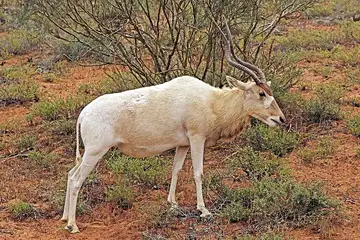
Scimitar oryx. (150 kg vs 95 kg) Addax →
More like this


Sources
Updated: 2026-10-14