
Costa Rica: landmarks, animals & facts for kids
2 landmarks · 1 animal
Costa Rica on My Earth Toy, the free 3D toy globe for kids: 2 landmarks, 1 animal. Here you can see its flag, capital and size, then fly to every place on the globe.
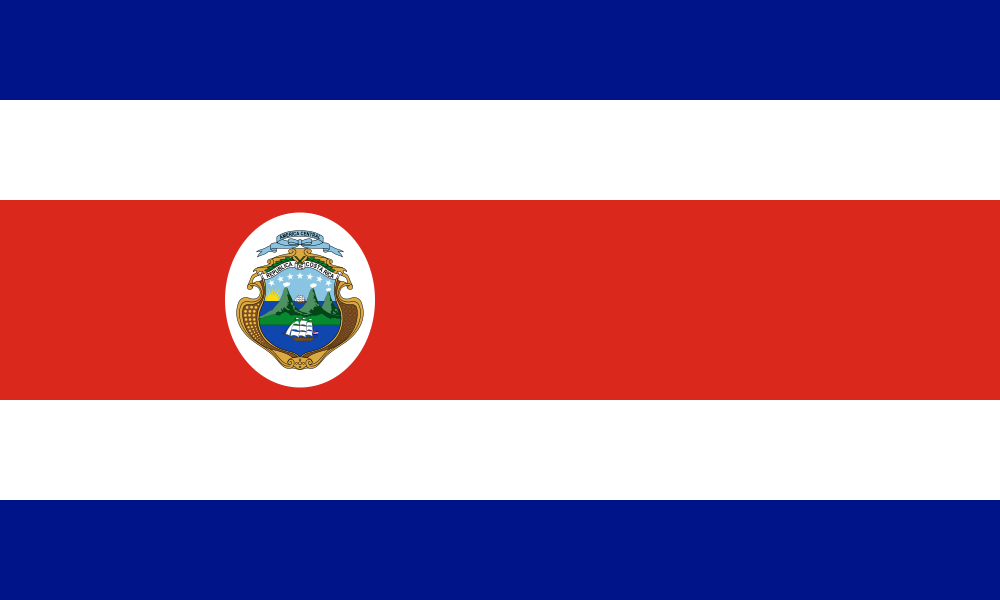
Costa Rica's flag has five horizontal stripes: blue, white, a wide red stripe in the middle, white and blue. The red stripe is twice as wide as each of the others.
Read about this flag →Costa Rica at a glance
- Capital
- San José
- Continent
- North America
- Area
- 51,100 km²
- Population
- 5.1 million
Costa Rica is a small country in Central America, between Nicaragua and Panama, with coastlines on both the Caribbean Sea and the Pacific Ocean. Its capital is San José, and about 5 million people live there. Costa Rica is known for its rainforests, volcanoes, beaches and amazing wildlife, and for protecting nature. It is also famous for having no army since 1948.
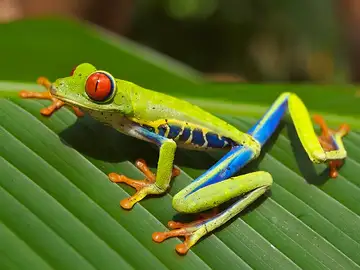
On My Earth Toy you can see Arenal Volcano, a cone-shaped volcano that erupted almost constantly for decades, and the National Theatre of Costa Rica in San José, an elegant building from the 1890s. Look for the red-eyed tree frog too, with its bright green body and big red eyes.
Geography and nature
A chain of volcanic mountains runs down the middle of Costa Rica, with active volcanoes such as Arenal, Poás and Irazú. The highlands have cool cloud forests, like Monteverde, wrapped in mist. The lowlands are hot and covered in rainforest, mangroves and dry forest. Although Costa Rica covers only a tiny part of the Earth, it is home to around 5 percent of all known species, including sloths, toucans, monkeys and sea turtles.
People, languages and culture
Spanish is the official language, and Costa Ricans call themselves 'Ticos'. A common saying is 'pura vida', meaning 'pure life', used as a greeting and to say things are good. Most people are Christian. Gallo pinto, rice and beans fried together, is a typical breakfast. Coffee has been grown here for nearly two centuries. Traditional ox carts, painted with bright patterns, are a national symbol and recognised by UNESCO.
History in a nutshell
Indigenous peoples lived here long before Christopher Columbus reached the coast in 1502. Spain ruled the region for about three centuries, and Costa Rica became independent in 1821 along with the rest of Central America. Coffee exports made the country richer in the 1800s, paying for buildings such as the National Theatre. After a short civil war in 1948, Costa Rica abolished its army and invested in schools and health care.
Fun facts
- About a quarter of Costa Rica's land is protected in national parks and reserves.
- Almost all of Costa Rica's electricity comes from renewable sources such as water, wind and volcanic heat.
- Sloths come down from their trees only about once a week to go to the toilet.
- Red-eyed tree frogs sleep in the daytime with their eyes closed and their colours hidden.
Famous landmarks in Costa Rica
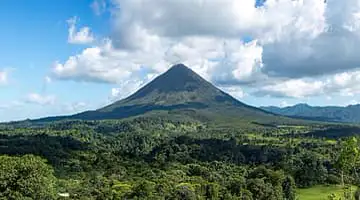
Arenal Volcano
Costa Rica · North America
A near-perfect cone volcano surrounded by rainforest and hot springs.
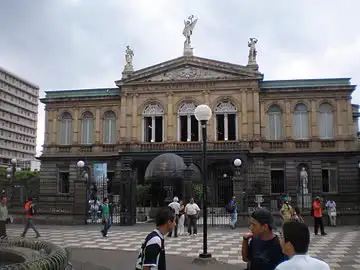
National Theatre of Costa Rica
Costa Rica · North America
A neoclassical theatre paid for by a coffee export tax, its roof crowned by statues of Fame, Dance and Music.
Animals in Costa Rica
Questions
What is the capital of Costa Rica?
The capital of Costa Rica is San José.
Which continent is Costa Rica in?
Costa Rica is in North America.
How big is Costa Rica?
Costa Rica covers about 51,100 km².
How many people live in Costa Rica?
About 5.1 million people live in Costa Rica.
What are the most famous landmarks in Costa Rica?
Some of the best-known landmarks in Costa Rica are Arenal Volcano and National Theatre of Costa Rica. My Earth Toy has 2 landmarks from Costa Rica on its free 3D globe, each with a photo and quick facts.
Which animals can you find in Costa Rica on My Earth Toy?
On the globe you can find Red-eyed tree frog in Costa Rica.
Sources
Updated: 2026-10-30