
Arenal Volcano
아레날 화산
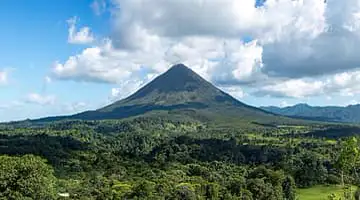
Arenal Volcano is a cone-shaped volcano in north-western Costa Rica, in Central America, about 90 kilometres north-west of the capital, San José. It rises more than 1,600 metres high and has an almost perfect cone with a crater about 140 metres wide at the top. It stands at the centre of Arenal Volcano National Park, near the town of La Fortuna.
See it on the 3D globe →At a glance
- Country
- Costa Rica
- Location
- Alajuela, Costa Rica
- Height
- 1,633 m
- Type
- Volcano
Quick answers
Where is Arenal Volcano?
Arenal Volcano is in Alajuela, Costa Rica.
A near-perfect cone volcano surrounded by rainforest and hot springs.
Arenal is a stratovolcano, a steep volcano built up from many layers of hardened lava and ash. Geologists think it is less than about 7,500 years old, which makes it the youngest volcano in Costa Rica. For centuries it slept quietly under a blanket of forest, until it suddenly woke up in 1968 and then kept erupting for 42 years. Since 2010 it has been resting.
The eruption of 1968
Before 1968, local people did not even think of Arenal as a dangerous volcano; they called it Cerro Arenal, "Arenal Hill". Then, at 7:30 in the morning on Monday 29 July 1968, it exploded. The eruptions went on for several days, throwing rocks weighing several tonnes more than a kilometre away and burying about 15 square kilometres under rock, lava and ash. Three small villages on the western side, Tabacón, Pueblo Nuevo and San Luís, were destroyed, and 87 people died. The blasts opened three new craters on the volcano's side.
Forty-two years of eruptions
After 1968 Arenal never fully calmed down. Until 2010 it erupted almost every day, sending lava flows and clouds of hot ash and gas down its slopes. It became Costa Rica's most active volcano and one of the ten most active in the world, and scientists studied it closely. Measured by how long it lasted, the 1968 to 2010 eruption is the tenth longest volcanic eruption on Earth since 1750. Since 2010 Arenal has been dormant, which means resting but not extinct, so it could become active again one day.
Living next to a volcano
The town on the eastern side of the volcano, La Fortuna, was not harmed in 1968. A popular story says it was renamed "The Fortune" because it was lucky, but in fact it already had that name before the eruption, chosen for its flat, fertile farmland. Nearby lies Lake Arenal, a reservoir whose water is used to make hydroelectric power; it covered the old village of Arenal when it was created. Today visitors hike the national park's trails for close views of the cone.
Fun facts
- Before 1968, Arenal had been quiet for so long that many people thought it was extinct.
- Its 1968 to 2010 eruption is the tenth longest on Earth since 1750.
- At its strongest, the 1968 eruption threw rocks weighing several tonnes more than a kilometre.
- The town of La Fortuna got its name before the eruption, not because it escaped it.
On the globe
The model shows Arenal's near-perfect volcanic cone rising above the green rainforest of northern Costa Rica. Zoom in to see its steep, even slopes and the crater at the top.
Nearby on the globe
_(cropped).jpg)
Sources
- Read more on Wikipedia
- Arenal Volcano — Wikipedia
- 아레날 화산 — 위키백과
- Costa Rica, Arenal Volcano – 1968 Eruption — Arenal.net
Updated: 2026-10-13