
Czechia: landmarks, animals & facts for kids
2 landmarks
Czechia on My Earth Toy, the free 3D toy globe for kids: 2 landmarks. Here you can see its flag, capital and size, then fly to every place on the globe.
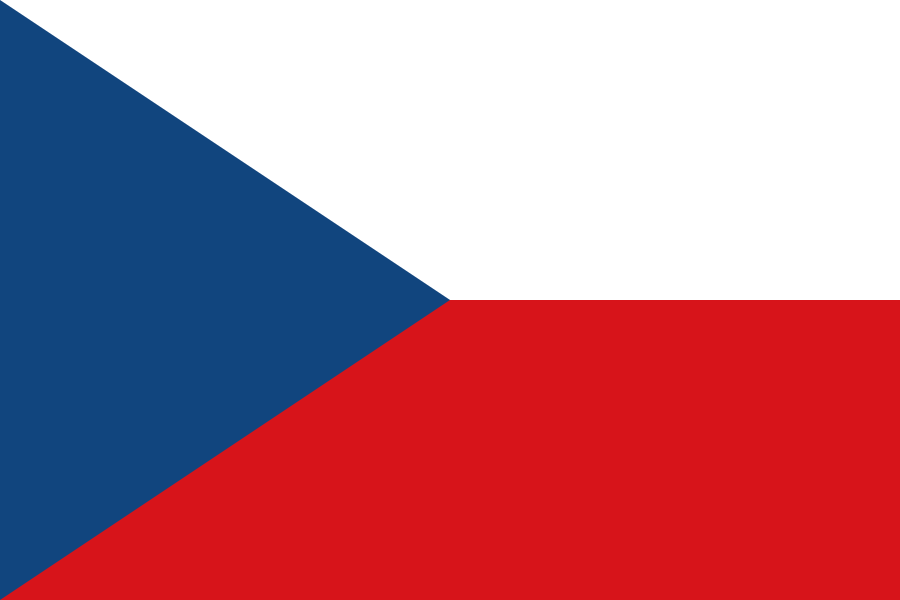
The Czech flag has a white stripe on top and a red stripe below, with a blue triangle pointing in from the flagpole side and reaching halfway across.
Read about this flag →Czechia at a glance
- Capital
- Prague
- Continent
- Europe
- Area
- 78,871 km²
- Population
- 10.7 million
Czechia, also called the Czech Republic, is a landlocked country in Central Europe, surrounded by Germany, Poland, Slovakia and Austria. Its capital is Prague, a city of spires and bridges on the Vltava River, and about 10.9 million people live there. Czechia is known for its castles, fairy-tale old towns, glassmaking, puppets and beer. Its towns and castles look like scenes from a storybook.
On My Earth Toy you can visit Charles Bridge and Prague Castle, with the Gothic towers of St. Vitus Cathedral rising above the river, and the Prague Astronomical Clock in the Old Town Square, where little figures of the apostles parade every hour.
Geography and nature
Czechia is made up of three historic lands: Bohemia in the west, Moravia in the east and a small part of Silesia. Bohemia is a basin ringed by forested mountains, including the Krkonoše, where Sněžka, the highest peak, rises to about 1,600 metres. Rivers such as the Vltava and Elbe flow north to Germany. Bohemian Switzerland has dramatic sandstone rock towers and the Pravčická Gate, a huge natural arch. Forests cover about a third of the country.
People, languages and culture
People speak Czech, a Slavic language. Many Czechs do not follow a religion, and the largest church is Roman Catholic. Puppet theatre is a beloved tradition, and the cartoon Little Mole (Krtek) is famous across Europe. Bohemian crystal glass is admired worldwide. Popular foods include roast pork with dumplings and sauerkraut, and sweet fruit dumplings. Ice hockey is the favourite sport, and composers Antonín Dvořák and Bedřich Smetana were Czech.
History in a nutshell
In the Middle Ages the Kingdom of Bohemia was powerful, and Prague was the capital of the Holy Roman Empire under Charles IV, who founded Charles University in 1348 and began the Charles Bridge. Later the Habsburgs ruled. In 1918 Czechoslovakia was founded. After World War II it had a communist government until the peaceful Velvet Revolution of 1989. On 1 January 1993 Czechoslovakia split peacefully into Czechia and Slovakia.
Fun facts
- The word 'robot' was first used in a 1920 play by the Czech writer Karel Čapek.
- The Prague Astronomical Clock was first installed in 1410 and is the oldest astronomical clock still working.
- Czechia has more than 2,000 castles and chateaux.
- Pilsner, a pale lager beer, was first brewed in the Czech city of Plzeň in 1842.
Famous landmarks in Czechia
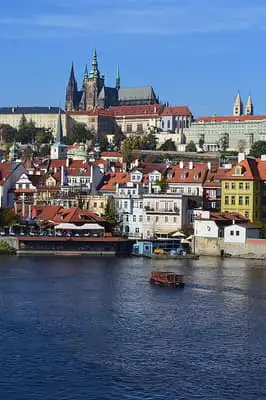
Charles Bridge & Prague Castle
Czechia · Europe
A medieval stone bridge over the Vltava lined with statues, overlooked by hilltop Prague Castle.
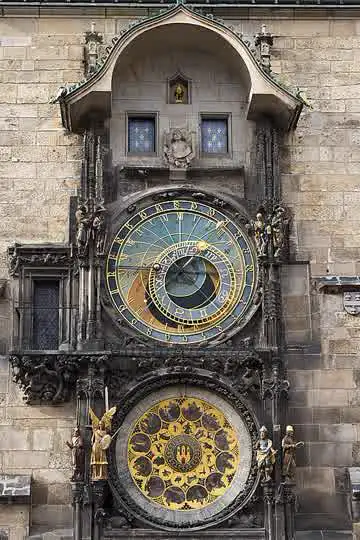
Prague Astronomical Clock
Czechia · Europe
A 1410 astronomical clock on the Old Town Hall tower; the Twelve Apostles parade past its windows every hour.
Questions
What is the capital of Czechia?
The capital of Czechia is Prague.
Which continent is Czechia in?
Czechia is in Europe.
How big is Czechia?
Czechia covers about 78,871 km².
How many people live in Czechia?
About 10.7 million people live in Czechia.
What are the most famous landmarks in Czechia?
Some of the best-known landmarks in Czechia are Charles Bridge & Prague Castle and Prague Astronomical Clock. My Earth Toy has 2 landmarks from Czechia on its free 3D globe, each with a photo and quick facts.
Sources
Updated: 2026-10-30