
Ghana: landmarks, animals & facts for kids
2 landmarks
Ghana on My Earth Toy, the free 3D toy globe for kids: 2 landmarks. Here you can see its flag, capital and size, then fly to every place on the globe.
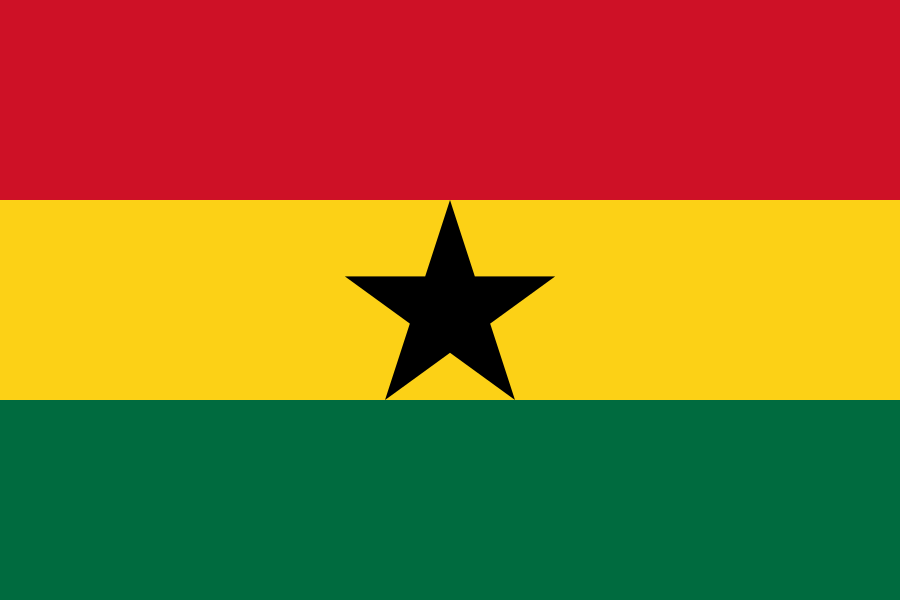
Ghana's flag has three horizontal stripes, red, gold and green, with a black five-pointed star in the middle of the gold stripe.
Read about this flag →Ghana at a glance
- Capital
- Accra
- Continent
- Africa
- Area
- 238,533 km²
- Population
- 34.4 million
Ghana is a country in West Africa on the Gulf of Guinea, between Côte d'Ivoire and Togo, with Burkina Faso to the north. Its capital, Accra, sits on the Atlantic coast. Ghana is famous for gold (the British called it the Gold Coast), for cocoa farms that help make the world's chocolate, and for colourful kente cloth. In 1957 it became the first colony in sub-Saharan Africa to win its independence.
On My Earth Toy you can fly to Cape Coast Castle, a white seaside fort that was once a centre of the Atlantic slave trade and is now a museum and memorial. Far to the north stands the Larabanga Mosque, a small whitewashed mud mosque that is said to be one of the oldest in West Africa.
Geography and nature
Southern Ghana has rainforest, cocoa farms and a coast lined with sandy beaches and old European forts. Further north the land turns into dry grassy savanna. The Volta River runs through the middle of the country, and the Akosombo Dam, finished in 1965, turned part of it into Lake Volta, the largest artificial lake in the world by surface area. The highest point, Mount Afadjato, is only 885 metres tall. Near Cape Coast, Kakum National Park lets visitors walk on rope bridges high in the forest treetops.
People, languages and culture
English is the official language, but Ghanaians speak dozens of local languages, such as Akan (including Twi and Fante), Ewe, Ga and Dagbani. Most people are Christian, and about one in five is Muslim. Kente, a cloth woven in narrow bright strips, comes from the Asante and Ewe peoples, and each pattern has its own name and meaning. Popular foods include jollof rice, fufu and banku, and Ghana gave the world highlife, a cheerful style of dance music.
History in a nutshell
By the 12th century, gold was making the Bono state in the south rich, and later the powerful Asante Empire grew there, while the Kingdom of Dagbon ruled in the north. Portuguese traders arrived in the 15th century, followed by other Europeans who built forts along the coast and took part in the slave trade. Britain made the area the Gold Coast colony. Led by Kwame Nkrumah, the country became independent on 6 March 1957 and took the name Ghana from an ancient West African empire.
Fun facts
- The name Ghana comes from an old empire that actually lay hundreds of kilometres to the northwest, in today's Mali and Mauritania.
- Lake Volta covers more surface than any other lake made by people.
- The Prime Meridian, the 0° longitude line, runs through Ghana near the port city of Tema.
- Ghana's national football team is nicknamed the Black Stars, after the black star on the flag.
Famous landmarks in Ghana
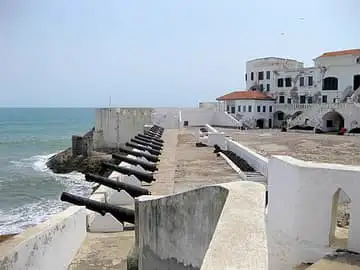
Cape Coast Castle
Ghana · Africa
A coastal fort that served as a hub of the Atlantic slave trade, now a sobering memorial and museum.
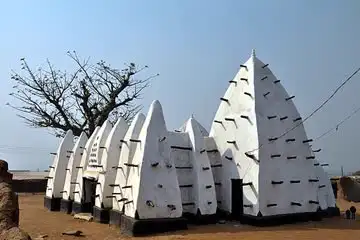
Larabanga Mosque
Ghana · Africa
A whitewashed Sudano-Sahelian mud mosque, reputed to be one of the oldest in West Africa.
Questions
What is the capital of Ghana?
The capital of Ghana is Accra.
Which continent is Ghana in?
Ghana is in Africa.
How big is Ghana?
Ghana covers about 238,533 km².
How many people live in Ghana?
About 34.4 million people live in Ghana.
What are the most famous landmarks in Ghana?
Some of the best-known landmarks in Ghana are Cape Coast Castle and Larabanga Mosque. My Earth Toy has 2 landmarks from Ghana on its free 3D globe, each with a photo and quick facts.
Sources
Updated: 2026-10-30