
Larabanga Mosque
라라방가 모스크
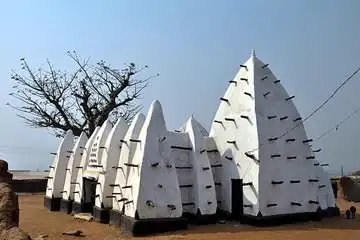
The Larabanga Mosque is a small whitewashed mud mosque in the village of Larabanga in northern Ghana. It is regarded as the oldest mosque in Ghana and one of the oldest in West Africa, and some people call it the Mecca of West Africa. It is built in the Sudanic-Sahelian style, using local earth and wood.
See it on the 3D globe →At a glance
- Country
- Ghana
- Location
- Larabanga, Ghana
- Built
- c. 1421
- Type
- Religious building
Quick answers
Where is Larabanga Mosque?
Larabanga Mosque is in Larabanga, Ghana.
A whitewashed Sudano-Sahelian mud mosque, reputed to be one of the oldest in West Africa.
Legend dates it to 1421, but the story is a tradition, not a proven date. The mosque is only about 8 metres by 8 metres, much smaller than city mosques such as the Great Mosque of Djenné that inspired its look. The village lies about 15 kilometres north of Damongo and 4 kilometres south of the entrance to Mole National Park.
The legend of the mosque
A story says that in 1421 a trader named Ayuba had a dream near a 'mystic stone' telling him to build a mosque. When he woke, the foundations were already there, so he built it. He is said to have asked to be buried nearby, with the baobab tree that would grow from his grave kept for generations. A baobab beside the mosque is believed to mark his grave. Another local tradition says an old Quran was given from heaven in 1650 to the imam Bramah.
Mud, wood and white wash
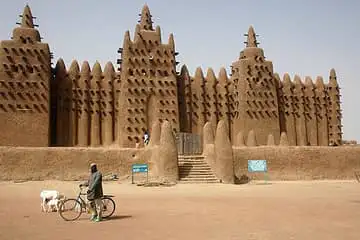
The walls are wattle and daub, a framework of wood covered in mud, and everything is whitewashed. Two pyramid-shaped towers stand at the east front and the northeast corner: one marks the mihrab, the niche that points toward Mecca, and the other is the minaret. Twelve cone-shaped buttresses support the walls, tied together with timber. The buttresses were needed because the building materials were weaker than those used by the bigger mosques it copied.
Saved by the community
In the 1970s a sand-and-cement coating was put on the walls to protect them, but it trapped moisture and caused damage, and termites attacked the wood. In September 2002 a storm destroyed the mihrab and the minaret. The World Monuments Fund helped with restoration, advised by the earthen-building specialists CRAterre. Local craftspeople took off the cement, replaced timbers and replastered the walls the traditional way. Visitors' crafts and tourism projects now help pay for upkeep.
Fun facts
- The mosque measures only about 8 metres by 8 metres.
- Twelve cone-shaped buttresses support its walls.
- A baobab tree beside it is said to mark the grave of its legendary builder.
- A cement coating from the 1970s hurt the mud walls by trapping moisture.
On the globe
The model shows the whitewashed mud mosque with its pyramid-shaped towers. Look at the rounded buttresses along the walls.
Nearby on the globe

Sources
Updated: 2026-10-14