
Guinea-Bissau: landmarks, animals & facts for kids
1 landmark
Guinea-Bissau on My Earth Toy, the free 3D toy globe for kids: 1 landmark. Here you can see its flag, capital and size, then fly to every place on the globe.
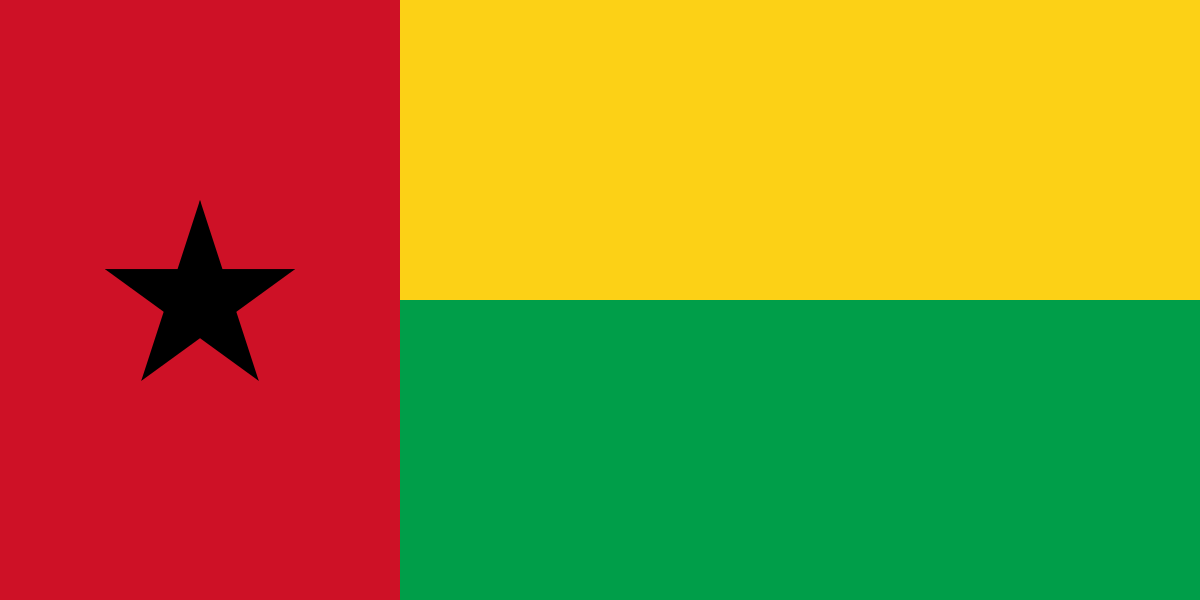
Guinea-Bissau's flag has a red vertical band at the flagpole side with a black five-pointed star, and two horizontal stripes, yellow over green, on the rest of the flag.
Read about this flag →Guinea-Bissau at a glance
- Capital
- Bissau
- Continent
- Africa
- Area
- 36,125 km²
- Population
- 2.2 million
Guinea-Bissau is a small country on the Atlantic coast of West Africa, between Senegal and Guinea. Its capital is Bissau, a port on the estuary of the Geba River. The country is low and green, with mangrove swamps, rice fields and the Bijagós Archipelago, a group of dozens of islands rich in wildlife. Cashew nuts grown on its farms are its most important export.
On My Earth Toy you can see the Pidjiguiti Memorial in Bissau, a giant black clenched fist known as the Hand of Timba. It honours the dock workers who were killed during a strike at the port in 1959, an event that became a symbol of the struggle for independence.
Geography and nature
Most of Guinea-Bissau is flat and close to sea level; its highest point is only about 277 metres high. Rivers wind through mangrove forests to the coast, and tides flood far inland. Offshore, the Bijagós Archipelago is a UNESCO biosphere reserve where sea turtles nest on sandy beaches and huge flocks of migratory birds stop to feed. On some islands, hippos even swim in salty sea water, something very unusual for hippos.
People, languages and culture
Portuguese is the official language, but the language most people use every day is Kriol, a creole based on Portuguese mixed with African languages. The country has many ethnic groups, including the Balanta, Fula, Mandinka, Papel and Manjaco. Islam, Christianity and traditional beliefs are all practised. On the Bijagós Islands, local communities keep old customs and sacred places, and the Carnival in Bissau is famous for its masks and costumes.
History in a nutshell
For centuries the area belonged to the Mali Empire and later to the Kingdom of Kaabu. Portuguese traders set up posts on the coast in the 16th century, and by the 19th century the region had become the colony of Portuguese Guinea. A war for independence was led by the PAIGC party and its founder Amílcar Cabral. Independence was declared in 1973 and recognised by Portugal in 1974. Since then the country has faced periods of political instability.
Fun facts
- The highest point in Guinea-Bissau is lower than the Eiffel Tower.
- Hippos on the Bijagós Islands swim between islands through salt water.
- Kriol is spoken by far more people in Guinea-Bissau than Portuguese, the official language.
- Guinea-Bissau declared independence in 1973, a year before Portugal recognised it.
Famous landmarks in Guinea-Bissau
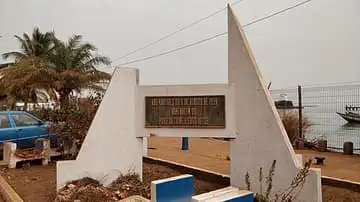
Pidjiguiti Memorial
Guinea-Bissau · Africa
The giant black clenched fist known as the Hand of Timba, honouring the dock workers killed in the 1959 Pidjiguiti strike at Bissau's port, a symbol of the independence struggle.
Questions
What is the capital of Guinea-Bissau?
The capital of Guinea-Bissau is Bissau.
Which continent is Guinea-Bissau in?
Guinea-Bissau is in Africa.
How big is Guinea-Bissau?
Guinea-Bissau covers about 36,125 km².
How many people live in Guinea-Bissau?
About 2.2 million people live in Guinea-Bissau.
What are the most famous landmarks in Guinea-Bissau?
On My Earth Toy's free 3D globe, the landmark from Guinea-Bissau is Pidjiguiti Memorial, with a photo and quick facts.
Sources
Updated: 2026-10-30