
Guyana: landmarks, animals & facts for kids
1 landmark
Guyana on My Earth Toy, the free 3D toy globe for kids: 1 landmark. Here you can see its flag, capital and size, then fly to every place on the globe.
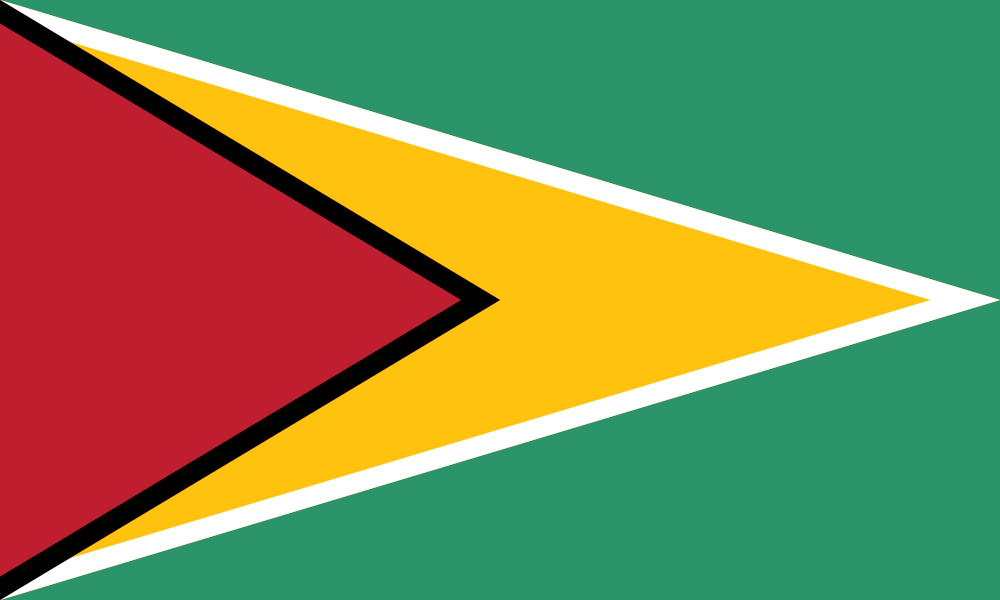
Guyana's flag is green with a long golden triangle edged in white pointing from the flagpole to the far edge, and a smaller red triangle edged in black on top of it.
Read about this flag →Guyana at a glance
- Capital
- Georgetown
- Continent
- South America
- Area
- 214,969 km²
- Population
- 0.8 million
Guyana is a country on the north coast of South America, between Venezuela and Suriname, with Brazil to the south. Its capital is Georgetown. The name is often said to mean land of many waters, and the country is crossed by big rivers and covered mostly by rainforest. Guyana is the only country in South America where English is the official language, and it has close ties with the Caribbean.
On My Earth Toy you can fly to Kaieteur Falls, where the Potaro River plunges 226 metres in a single drop, making it one of the most powerful single-drop waterfalls on Earth. Look for it deep in the forest of central Guyana.
Geography and nature
Most people live on a narrow coastal plain, parts of which lie below sea level at high tide, so a long sea wall and drainage canals built since Dutch times keep the water out. Inland lie huge rainforests, the grassy Rupununi savanna and the flat-topped mountains of the Guiana Highlands. The highest point is on Mount Roraima, 2,775 metres tall. Guyana is home to jaguars, giant river otters, giant anteaters and the harpy eagle. Its national flower is the giant water lily.
People, languages and culture
English is the official language, but most Guyanese also speak Guyanese Creole. The largest groups are people of Indian descent and of African descent, along with people of mixed heritage, Indigenous peoples, and smaller Chinese and Portuguese communities. Hindu, Christian and Muslim holidays are all celebrated. Cricket is hugely popular, and Guyanese players take part in the West Indies team. Each February, the Mashramani festival marks Republic Day with costumes, music and parades.
History in a nutshell
Indigenous peoples such as the Arawak and Carib lived here long before Europeans arrived. The Dutch set up colonies in the 17th century, and by 1815 the area had passed to Britain, later becoming British Guiana. Enslaved Africans were forced to work on sugar plantations; after slavery ended, workers came from India under contracts called indenture. Guyana became independent on 26 May 1966 and became a republic in 1970. In 2015, large oil reserves were found off its coast.
Fun facts
- Kaieteur Falls drops roughly four times as far as Niagara Falls.
- The leaves of the giant water lily, Guyana's national flower, can grow wider than a grown-up is tall.
- The hoatzin, Guyana's national bird, has chicks with little claws on their wings for climbing.
- Guyana is the only South American country whose official language is English.
Famous landmarks in Guyana
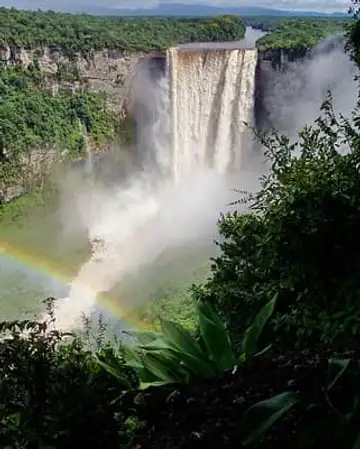
Kaieteur Falls
Guyana · South America
The Potaro River plunges 226 m in a single drop here, making it one of the most powerful single-drop waterfalls in the world.
Questions
What is the capital of Guyana?
The capital of Guyana is Georgetown.
Which continent is Guyana in?
Guyana is in South America.
How big is Guyana?
Guyana covers about 214,969 km².
How many people live in Guyana?
About 0.8 million people live in Guyana.
What are the most famous landmarks in Guyana?
On My Earth Toy's free 3D globe, the landmark from Guyana is Kaieteur Falls, with a photo and quick facts.
Sources
Updated: 2026-10-30