
Mauritius: landmarks, animals & facts for kids
1 landmark
Mauritius on My Earth Toy, the free 3D toy globe for kids: 1 landmark. Here you can see its flag, capital and size, then fly to every place on the globe.
Mauritius at a glance
- Capital
- Port Louis
- Continent
- Africa
- Area
- 2,040 km²
- Population
- 1.3 million
Mauritius is an island country in the Indian Ocean, about 2,000 kilometres off the southeast coast of Africa and east of Madagascar. Its capital is Port Louis. The main island is volcanic and almost completely surrounded by coral reefs, with turquoise lagoons, sugar-cane fields and green mountains. Mauritius is also known as the only home of the dodo, a flightless bird that died out in the 17th century, and for its mix of cultures from Africa, India, China and Europe.
On My Earth Toy you can see Le Morne Brabant, a dramatic basalt mountain on a peninsula in the southwest. It is a UNESCO World Heritage Site because enslaved people who escaped once hid in its caves and on its steep summit.
Geography and nature
The main island rose from the sea as a volcano millions of years ago. Its centre is a plateau ringed by jagged peaks, the highest being Piton de la Petite Rivière Noire at 828 metres. At Chamarel, sand dunes of several different colours lie side by side. The country also includes Rodrigues and other smaller islands. After the dodo disappeared, conservationists worked hard to save other rare birds, such as the pink pigeon and the Mauritius kestrel.
People, languages and culture
Most Mauritians speak Mauritian Creole at home, while English and French are used in government, schools and newspapers. Many people have Indian ancestors, and others have African, Chinese or French roots. Hinduism is the largest religion, followed by Christianity and Islam, and festivals of every faith are public holidays. Sega, a lively music and dance that began among enslaved Africans, is listed by UNESCO. Food mixes curries, Creole stews, Chinese noodles and French bread.
History in a nutshell
Arab and Portuguese sailors knew of the island, but no one lived here until the Dutch settled in 1638 and named it after Prince Maurice of Nassau. The French took over in 1715 and brought enslaved Africans to work on plantations. Britain captured Mauritius in 1810. After slavery ended, hundreds of thousands of indentured workers arrived from India through the immigration depot now called Aapravasi Ghat. Mauritius became independent on 12 March 1968 and a republic in 1992.
Fun facts
- The dodo, which lived only on Mauritius, is now a famous symbol of extinction, and it appears on the country's coat of arms.
- In 1974 only four Mauritius kestrels were known in the wild; careful conservation helped the species recover.
- Off the coast near Le Morne, sand flowing down the seafloor creates the illusion of an underwater waterfall when seen from above.
- Mauritius was uninhabited until the 17th century.
Famous landmarks in Mauritius
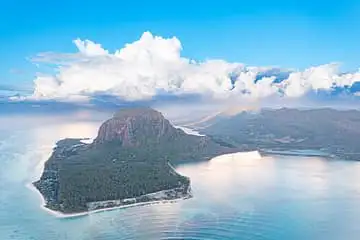
Le Morne Brabant
Mauritius · Africa
A basalt mountain jutting into the lagoon, once a refuge for escaped slaves.
Questions
What is the capital of Mauritius?
The capital of Mauritius is Port Louis.
Which continent is Mauritius in?
Mauritius is in Africa.
How big is Mauritius?
Mauritius covers about 2,040 km².
How many people live in Mauritius?
About 1.3 million people live in Mauritius.
What are the most famous landmarks in Mauritius?
On My Earth Toy's free 3D globe, the landmark from Mauritius is Le Morne Brabant, with a photo and quick facts.
Sources
Updated: 2026-10-30