
Namibia: landmarks, animals & facts for kids
1 landmark · 2 animals · 1 place to discover
Namibia on My Earth Toy, the free 3D toy globe for kids: 1 landmark, 2 animals, 1 place to discover. Here you can see its flag, capital and size, then fly to every place on the globe.
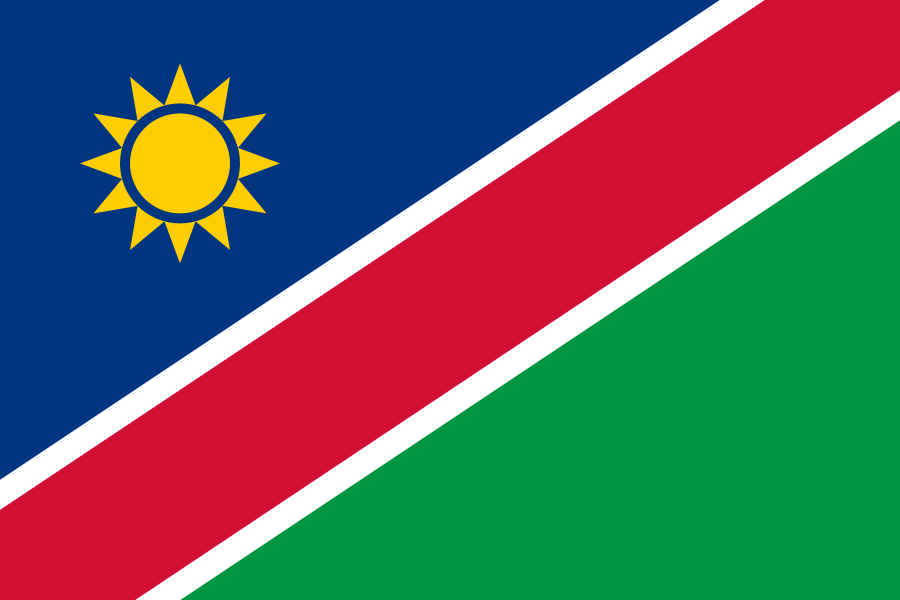
Namibia's flag is cut by a red diagonal band edged in white, with a blue triangle holding a gold sun at the top and a green triangle at the bottom.
Read about this flag →Namibia at a glance
- Capital
- Windhoek
- Continent
- Africa
- Area
- 825,615 km²
- Population
- 3 million
Namibia is a country in southwestern Africa on the Atlantic Ocean, bordered by Angola, Zambia, Botswana and South Africa. Its capital is Windhoek. Named after the Namib Desert, which is thought to be the oldest desert in the world, Namibia is one of the most thinly populated countries on Earth. It is famous for towering red sand dunes, the foggy Skeleton Coast, wildlife-rich Etosha and its large population of wild cheetahs.
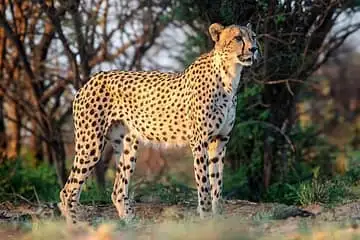
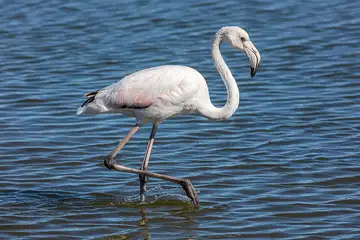
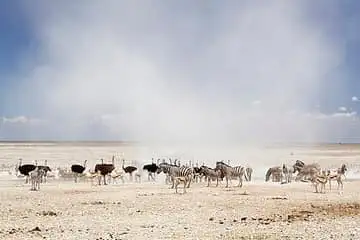
On My Earth Toy you can visit Sossusvlei and Deadvlei, where some of the highest sand dunes in the world surround a white clay pan dotted with dead, blackened camelthorn trees. Look for the cheetah and the greater flamingo, and discover Etosha National Park.
Geography and nature
The Namib Desert runs along the whole coast, where cold ocean currents create fog that beetles and plants drink from. Inland, a high plateau rises to mountains such as the Brandberg, the country's highest point at 2,573 metres. In the north, the Etosha Pan is a vast salt flat that attracts elephants, lions and rhinos to its waterholes. The Fish River Canyon in the south is one of the largest canyons in Africa. The strange welwitschia plant can live for more than a thousand years.
People, languages and culture
English is the official language, but most Namibians speak other languages at home, such as Oshiwambo, Nama-Damara, which uses click sounds, Herero, Afrikaans or German. Most people are Christian. The Himba people of the northwest are known for covering their skin and hair with a red paste of ochre and butter, and many Herero women wear long dresses with a hat shaped like cattle horns. Namibia was one of the first countries to protect nature in its national constitution.
History in a nutshell
The San have lived in southern Africa for many thousands of years, and their rock engravings at Twyfelfontein are a UNESCO World Heritage Site. Later, Nama, Herero, Ovambo and other peoples settled the land. Germany made it a colony, German South West Africa, in 1884, and between 1904 and 1908 German troops killed tens of thousands of Herero and Nama people. After the First World War, South Africa ruled the territory. Following a long struggle, Namibia became independent on 21 March 1990.
Fun facts
- The Hoba meteorite, which lies where it fell in northern Namibia, is the largest known single meteorite on Earth, weighing around 60 tonnes.
- The dead trees of Deadvlei are hundreds of years old, but they have not rotted because the air is so dry.
- Namibia has the largest population of wild cheetahs in the world.
- Some beetles in the Namib Desert collect drinking water by tilting their bodies into the morning fog.
Famous landmarks in Namibia
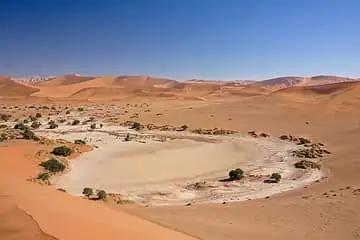
Sossusvlei & Deadvlei
Namibia · Africa
Towering red dunes surround white clay pans like Deadvlei, dotted with centuries-old dead trees.
Animals in Namibia
Places to discover in Namibia
Questions
What is the capital of Namibia?
The capital of Namibia is Windhoek.
Which continent is Namibia in?
Namibia is in Africa.
How big is Namibia?
Namibia covers about 825,615 km².
How many people live in Namibia?
About 3 million people live in Namibia.
What are the most famous landmarks in Namibia?
On My Earth Toy's free 3D globe, the landmark from Namibia is Sossusvlei & Deadvlei, with a photo and quick facts.
Which animals can you find in Namibia on My Earth Toy?
On the globe you can find Cheetah and Greater flamingo in Namibia.
Sources
Updated: 2026-10-30