
Greater flamingo
홍학
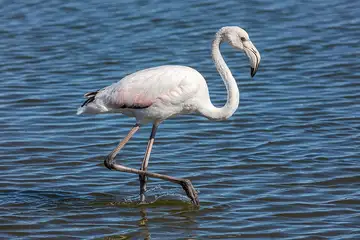
The largest and palest flamingo. It filters tiny crustaceans and algae through its downward-bent bill, and pigments in this food give its feathers their pink colour. It stands up to about 1.5 metres tall.
See it on the 3D globe →At a glance
- Class
- Birds
- Lives in
- Shallow salt lakes and lagoons such as Walvis Bay in Namibia
- Diet
- Filter feeder
- Weight
- about 3 kg
- Length
- about 1.3 m
- Top speed
- about 60 km/h
- Lifespan
- up to about 83 years
- Conservation status
- Least Concern (IUCN LC)
- Habitat
- wetlands, coasts
Quick answers
Where does the Greater flamingo live?
It lives in wetlands, coasts. On the globe you can find it near Shallow salt lakes and lagoons such as Walvis Bay in Namibia.
How big is the Greater flamingo?
It grows to about 1.3 m and 3 kg.
What does the Greater flamingo eat?
Its diet: filter feeder.
How fast is the Greater flamingo?
It can reach about 60 km/h.
How long does the Greater flamingo live?
It can live up to about 83 years.
Is the Greater flamingo endangered?
It is listed as Least Concern (IUCN LC).
The greater flamingo is the largest and most widespread of all flamingos. It stands about 110 to 150 centimetres tall, with a very long neck, long thin legs and a bill that bends sharply downward. Its feathers are pale pinkish-white, with red patches on the wings and black flight feathers that show when it flies.
It lives in shallow salty lagoons, lakes and coastal mudflats across Africa, southern Asia, the Middle East and southern Europe. Large flocks gather in places such as Walvis Bay in Namibia. Its pink colour comes from the tiny food it eats. It can stand in water for hours, balanced on one leg, while it feeds.
How does a flamingo eat?
A flamingo feeds with its head upside down in the water. It filters tiny crustaceans, algae and other small food from the water through its curved bill, which works like a sieve.
Colourful natural pigments in this food give flamingo feathers their pink shade. Birds that eat less of it look paler. The bill is turned upside down so that the upper half acts as the scoop.
Where it lives
The greater flamingo breeds in southern Europe, including the Camargue in France, and in Africa and Asia. The most northern breeding spot is Lake Tengiz in Kazakhstan, near 50 degrees north, where thousands of pairs nest.
Some small groups also live far from their usual range. A feral flock that probably descended from zoo escapees breeds in western Germany. Flocks of thousands can gather at one shallow lake or lagoon, so the shoreline may look pink from far away.
Fun facts
- A greater flamingo at Adelaide Zoo lived to at least 83, the oldest flamingo on record.
- It is the largest living flamingo.
- It feeds upside down, with its head dipped under the water.
- Its pale pink colour comes from pigments in its food.
On the globe
The globe places the greater flamingo in shallow lagoons such as Walvis Bay in Namibia. Look for the long legs and the bent bill.
Quiz time
Which is heavier: Greater flamingo or Common ostrich?
Show the answer
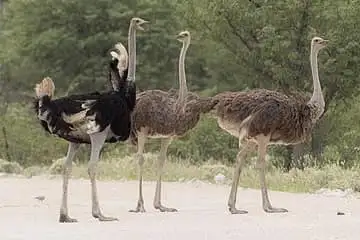
Common ostrich. (3 kg vs 100 kg) Common ostrich →
More like this
,_Walvis_Bay,_Namibia,_2018-08-05,_DD_30.jpg)
Sources
Updated: 2026-10-14