
Cheetah
치타
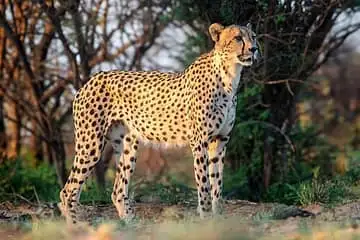
The fastest land animal on Earth, reaching nearly 100 km/h in about three seconds. Dark tear-like lines under its eyes cut sun glare while it hunts. It cannot roar like a lion; it purrs like a house cat instead.
See it on the 3D globe →At a glance
- Class
- Mammals
- Lives in
- Central Namibia
- Diet
- Meat eater (carnivore)
- Weight
- about 45 kg
- Length
- about 2 m
- Top speed
- about 100 km/h
- Lifespan
- up to about 20 years
- Conservation status
- Vulnerable (IUCN VU)
- Habitat
- savannas, grasslands, deserts
Quick answers
Where does the Cheetah live?
It lives in savannas, grasslands, deserts. On the globe you can find it near Central Namibia.
How big is the Cheetah?
It grows to about 2 m and 45 kg.
What does the Cheetah eat?
Its diet: meat eater (carnivore).
How fast is the Cheetah?
It can reach about 100 km/h.
How long does the Cheetah live?
It can live up to about 20 years.
Is the Cheetah endangered?
It is listed as Vulnerable (IUCN VU).
The cheetah is a slim, spotted wild cat and the fastest animal on land. In short bursts it can run at about 93 to 104 kilometres per hour, and it can go from standing still to almost 100 kilometres per hour in under three seconds, quicker than many sports cars. It has a small round head, a deep chest, long legs and a long tail.
Cheetahs once lived across much of Africa and south-west Asia. Today they survive mainly in small, scattered groups in eastern and southern Africa, with the largest numbers in countries such as Namibia and Botswana, and only a handful are left in Iran. Scientists estimated about 6,500 adult cheetahs in the wild in 2021, and the species is listed as Vulnerable, which means it is at risk of dying out.
Built for speed
Almost everything about a cheetah's body helps it sprint. Powerful back-leg muscles and a long, bendy spine let it take huge strides. Unlike most cats, its claws only pull back partly, so they grip the ground like the spikes on running shoes, and special paw pads add extra grip. Its long tail works like a boat's rudder, helping it turn sharply without tipping over. Dark tear-like stripes run from its eyes to its mouth; scientists think they may cut the sun's glare, though they are not sure.
What it eats
Cheetahs hunt mostly during the day, with the most activity around dawn and dusk. They prefer medium-sized hoofed animals such as impala, springbok and gazelles, usually weighing less than 40 kilograms. A cheetah sneaks to within about 30 to 200 metres of its prey, then explodes into a chase, trips the animal with a special claw on its front leg and holds it with a bite to the throat. Real hunts are usually run at around 54 kilometres per hour, much slower than its top speed.
Family life
Female cheetahs live alone and raise their cubs by themselves. After about three months a mother usually has three or four cubs. They start following her on hunts at around six weeks, and she later brings live prey for them to practise on. At about 18 months she leaves, and the brothers and sisters stay together for a few more months. Males often live in small groups called coalitions, usually made of brothers. Cheetahs cannot roar like lions; instead they purr, and chirp like birds to call each other.
Fun facts
- Cheetahs cannot roar; they purr, chirp and hiss instead.
- Every cheetah's spots and tail rings are unique, like a human fingerprint, so researchers can tell individuals apart.
- A cheetah cannot roar, but it purrs much louder than a pet cat.
- Mothers and cubs call to each other with high chirps that sound like a bird.
- In ancient Egypt, people tamed cheetahs, and in Arabia and India they were trained to hunt.
On the globe
The cheetah sits in central Namibia on the globe. Zoom in to spot its slim, spotted body and long tail, and watch it move across its home ground.
Quiz time
Which is heavier: Cheetah or Cape fur seal?
Show the answer
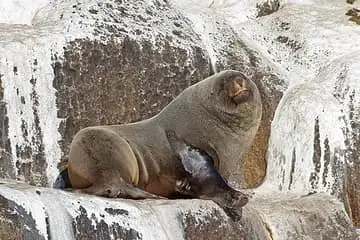
Cape fur seal. (45 kg vs 160 kg) Cape fur seal →
More like this

Sources
- Read more on Wikipedia
- Cheetah — Wikipedia
- 치타 — 위키백과
- Cheetah — Smithsonian's National Zoo & Conservation Biology Institute
Updated: 2026-10-13