
Niger: landmarks, animals & facts for kids
1 landmark · 1 animal
Niger on My Earth Toy, the free 3D toy globe for kids: 1 landmark, 1 animal. Here you can see its flag, capital and size, then fly to every place on the globe.
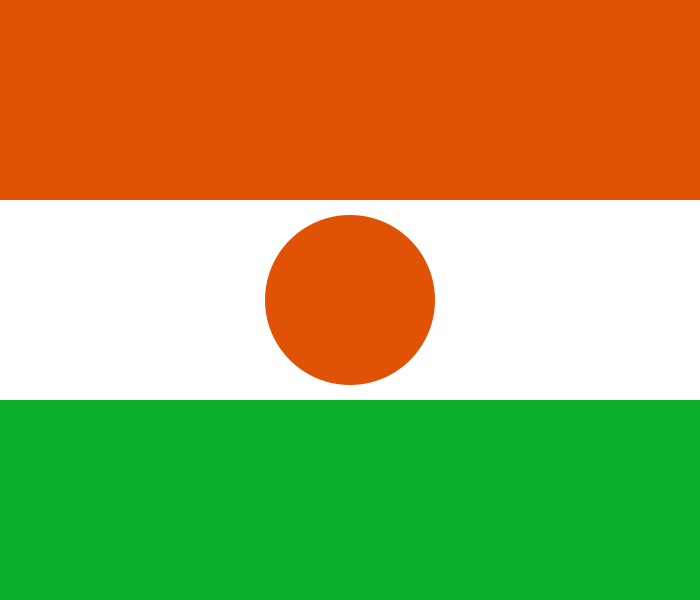
Niger's flag has three sideways stripes, orange, white and green, with an orange circle in the middle of the white stripe.
Read about this flag →Niger at a glance
- Capital
- Niamey
- Continent
- Africa
- Area
- 1,267,000 km²
- Population
- 27 million
Niger is a large landlocked country in West Africa, named after the Niger River, which flows through its southwest corner. Its capital, Niamey, lies on that river. Niger is the largest country in West Africa, but about four-fifths of it is desert, part of the Sahara, so most people live in the greener south. It is known for the Aïr Mountains, the sand seas of the Ténéré, Tuareg and Wodaabe traditions, dinosaur fossils and the last wild giraffes of West Africa.
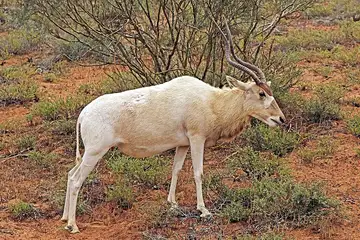
On My Earth Toy you can visit the Grand Mosque of Agadez, whose spiky mud-brick minaret, studded with wooden beams, is the tallest mud-brick minaret in the world. Look for the addax, a pale desert antelope with long twisted horns.
Geography and nature
Niger is one of the hottest countries on Earth. In the north lie the Aïr Mountains, rising to 2,022 metres at Idoukal-n-Taghes, and the Ténéré, a vast sea of sand dunes. The south is savanna where farmers grow millet and sorghum, and W National Park, shared with Benin and Burkina Faso, protects elephants, lions and buffalo. Near Kouré, not far from Niamey, a protected herd of West African giraffes roams freely among villages.
People, languages and culture
French is the official language, and many people speak Hausa, the most common language, or Zarma, Fula, Tamasheq or Kanuri. Nearly all people in Niger are Muslim. Tuareg herders are known for their indigo turbans and silver jewellery, such as the Agadez cross. Each year the Wodaabe hold the Gerewol, where young men dance and decorate their faces to impress the judges. Millet porridge and grilled meat are common foods.
History in a nutshell
Thousands of years ago the Sahara was green, and people carved giraffes and other animals into the rocks of the Aïr. Later, parts of Niger belonged to great states such as the Kanem-Bornu and Songhai empires, and Hausa city-states traded across the region. Agadez became a key stop for caravans crossing the Sahara, and its mosque was first built in the early 16th century. France colonised the area in the late 19th and early 20th centuries, and Niger became independent on 3 August 1960.
Fun facts
- The Ténéré Tree was once called the most isolated tree on Earth, the only tree for hundreds of kilometres, until a truck knocked it down in 1973.
- Nigersaurus, a dinosaur found in Niger, had a wide mouth with hundreds of small teeth that it replaced very often.
- West African giraffes now live in the wild only in Niger, most of them around Kouré.
- The minaret of the Agadez mosque is about 27 metres tall and is made almost entirely of mud brick.
Famous landmarks in Niger
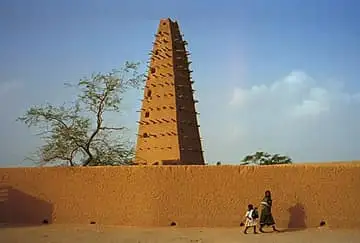
Grand Mosque of Agadez
Niger · Africa
The mud-brick mosque of the Saharan caravan town of Agadez, whose 27 m minaret, bristling with wooden toron beams, is the tallest mud-brick minaret in the world.
Animals in Niger
Questions
What is the capital of Niger?
The capital of Niger is Niamey.
Which continent is Niger in?
Niger is in Africa.
How big is Niger?
Niger covers about 1,267,000 km².
How many people live in Niger?
About 27 million people live in Niger.
What are the most famous landmarks in Niger?
On My Earth Toy's free 3D globe, the landmark from Niger is Grand Mosque of Agadez, with a photo and quick facts.
Which animals can you find in Niger on My Earth Toy?
On the globe you can find Addax in Niger.
Sources
Updated: 2026-10-30