
Addax
아닥스
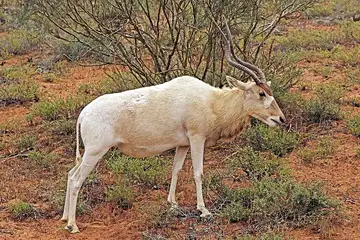
The addax is a Sahara antelope with long, spiralled horns. Its wide hooves help it walk on sand, and it can live with almost no drinking water by getting moisture from plants. It is critically endangered in the wild.
See it on the 3D globe →At a glance
- Class
- Mammals
- Lives in
- Sahara Desert (Niger and Chad)
- Diet
- Plant eater (herbivore)
- Weight
- about 95 kg
- Conservation status
- Critically Endangered (IUCN CR)
- Habitat
- deserts
Quick answers
Where does the Addax live?
It lives in deserts. On the globe you can find it near Sahara Desert (Niger and Chad).
How big is the Addax?
It grows to about 95 kg.
What does the Addax eat?
Its diet: plant eater (herbivore).
Is the Addax endangered?
It is listed as Critically Endangered (IUCN CR).
The addax is an antelope that lives in the Sahara. It is also called the white antelope or the screwhorn antelope because of its long, spiral horns. Females' horns are 55 to 80 cm long and males' are 70 to 85 cm. Today it is critically endangered.
Wild addax survive only in Chad, Mauritania and Niger, and it has disappeared from Western Sahara, Algeria, Libya, Egypt and Sudan. Unregulated hunting is a major threat. It is the only member of its genus, Addax, and it lives in herds of five to 20 animals. The only known self-sustaining wild population is in the Termit Massif Reserve in Niger. Addax have been reintroduced into Morocco and Tunisia.
Life in the desert
The addax lives in dry regions, semi-deserts and sandy and stony deserts, even where less than 100 mm of rain falls a year. It eats mainly grasses and the leaves of shrubs and herbs. It can live without drinking for long periods. Its coat changes with seasons: grey-brown with white legs and rump in winter, and almost white or sandy in summer. Its broad, flat hooves and strong dewclaws help it walk on soft sand.
Herds and young
Addax live in herds of five to 20, with males and females, usually led by one dominant male. They generally stay in one place and only wander widely in search of food, following rainfall to where plants are fresher. Breeding peaks in winter and early spring.
Males stand 105 to 115 cm high at the shoulder, and females are a little smaller. Wild addax live up to about 19 years. Because they move slowly, lions, leopards, cheetahs and humans can catch them, while caracals, servals and hyenas attack calves.
An old desert neighbour
Pictures in an Egyptian tomb from about 2500 BCE show addax tied to stakes, so ancient Egyptians may have kept them for a time. Addax once ranged from North Africa across Arabia, but poaching wiped them out in Egypt by the 1960s. A French scientist, Henri de Blainville, first described the species in 1816. Its face has a dark X-shaped patch across the nose and bright red nostrils.
Fun facts
- It can go for long periods without drinking, getting water from the plants it eats.
- Its spiral horns can reach 85 cm.
- The summer coat is almost white.
- It once lived across the Sahara but now survives in just three countries.
- Egyptians drew addax in tomb paintings around 2500 BCE.
On the globe
The model shows an addax with its spiralled horns. Look for the horns and the pale coat.
Quiz time
Which is heavier: Addax or Dromedary camel?
Show the answer
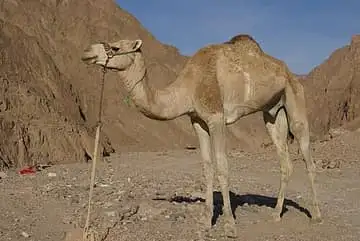
Dromedary camel. (95 kg vs 460 kg) Dromedary camel →
More like this

_female.jpg)
Sources
Updated: 2026-10-14