
Puerto Rico: landmarks, animals & facts for kids
1 landmark · 2 places to discover
Puerto Rico on My Earth Toy, the free 3D toy globe for kids: 1 landmark, 2 places to discover. Here you can see its flag, capital and size, then fly to every place on the globe.
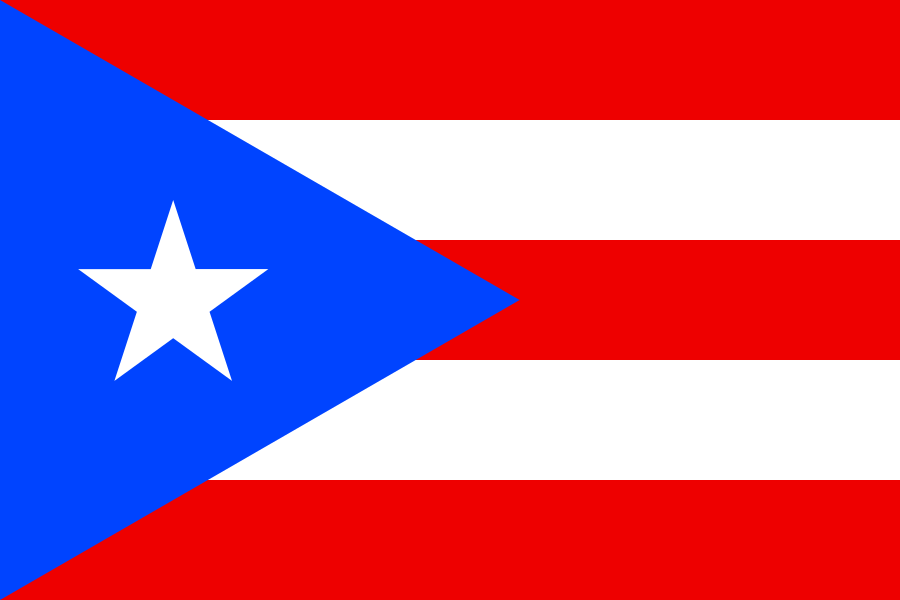
Puerto Rico's flag has five red and white stripes and a blue triangle at the pole with one white star.
Read about this flag →Puerto Rico at a glance
- Capital
- San Juan
- Continent
- North America
- Area
- 9,104 km²
- Population
- 3.2 million
Puerto Rico is a Caribbean island east of the Dominican Republic, in the Greater Antilles. It is a territory of the United States, not an independent country, and the people born there are US citizens. Its capital, San Juan, is one of the oldest cities founded by Europeans in the Americas.
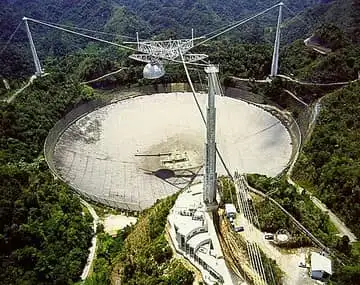
Puerto Rico is known for warm beaches, a tropical rainforest, glowing bays and lively music. On the globe you can find the Castillo San Felipe del Morro, a Spanish fortress guarding San Juan Bay, the giant Arecibo Observatory radio telescope and the legend of the chupacabra, a mysterious creature first reported here.
Geography and nature
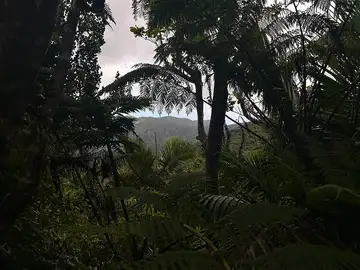
Puerto Rico is mostly mountainous, with the Cordillera Central running across the middle and flat coastal plains around the edge. In the north-east, El Yunque is the only tropical rainforest in the US National Forest System. Underground rivers have carved huge caves in the limestone. A few bays, such as Mosquito Bay on the island of Vieques, glow blue at night because of tiny living organisms in the water. The island's mascot is the coquí, a tiny tree frog whose loud 'ko-KEE' call fills the night.
People, languages and culture
Spanish and English are both official, but Spanish is spoken in most homes. Puerto Rican culture mixes Taíno, Spanish and African roots. Music is everywhere: salsa, the drum-based bomba and plena, and reggaeton, which grew up partly here. Popular foods include mofongo, mashed fried plantains with garlic, and arroz con gandules, rice with pigeon peas. Baseball is a passion; Roberto Clemente, one of the game's greats, was born here. Most people are Christian.
History in a nutshell
The Taíno people called the island Borikén. Christopher Columbus arrived in 1493, and Spain made it a colony, building forts like El Morro, begun in 1539, to defend San Juan from attackers. After the Spanish-American War in 1898, Spain gave Puerto Rico to the United States. Puerto Ricans became US citizens in 1917, and in 1952 the island became a self-governing commonwealth with its own constitution. Its future political status is still a subject of debate among Puerto Ricans.
Fun facts
- The Arecibo Observatory's dish was 305 metres wide and for decades was the largest single-dish radio telescope in the world; it collapsed in 2020.
- El Morro's walls rise about 40 metres above the sea.
- The chupacabra, said to drink the blood of goats, was first reported in Puerto Rico in 1995.
- Puerto Rico's flag looks like Cuba's with the colours swapped.
Famous landmarks in Puerto Rico
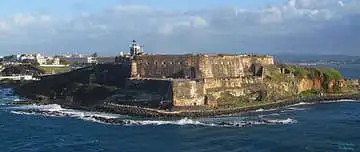
Castillo San Felipe del Morro
Puerto Rico · North America
A massive Spanish colonial citadel guarding the entrance to San Juan Bay.
Places to discover in Puerto Rico
Questions
What is the capital of Puerto Rico?
The capital of Puerto Rico is San Juan.
Which continent is Puerto Rico in?
Puerto Rico is in North America.
How big is Puerto Rico?
Puerto Rico covers about 9,104 km².
How many people live in Puerto Rico?
About 3.2 million people live in Puerto Rico.
What are the most famous landmarks in Puerto Rico?
On My Earth Toy's free 3D globe, the landmark from Puerto Rico is Castillo San Felipe del Morro, with a photo and quick facts.
Sources
Updated: 2026-10-30