
Arecibo Observatory
아레시보 천문대
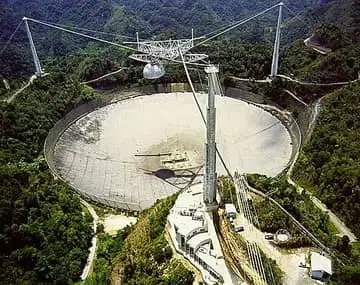
This radio telescope was built by laying a 305 m dish inside a natural limestone sinkhole in the Puerto Rican jungle. From 1963 it was the largest single-dish telescope in the world for over 50 years, and in 1974 it beamed the Arecibo message toward the stars for any aliens listening. Its 900-tonne instrument platform, hung on cables 137 m above the dish, crashed down in December 2020.
See it on the 3D globe →At a glance
- Country
- Puerto Rico
- Type
- Infrastructure
- Kind
- History
Quick answers
Where is Arecibo Observatory?
Arecibo Observatory is in Puerto Rico.
The Arecibo Telescope was a giant radio telescope in Puerto Rico. Its main dish was 305 metres across and built into a natural sinkhole near the town of Arecibo. A platform with the receivers and radar transmitters hung on cables about 150 metres above the dish.
Completed in November 1963, it was the largest single-dish telescope in the world for 53 years, until China's FAST telescope passed it in July 2016. Scientists used it to study stars, the atmosphere and asteroids, and to search for signals from alien intelligence. After two cable breaks in 2020, the platform fell into the dish on 1 December 2020, and the telescope was destroyed.
What it did
Arecibo could listen to radio waves from space, and it could also send radar signals out and read the echoes. That helped astronomers study planets, asteroids and the upper atmosphere.
NASA used it to look for near-Earth objects, and it supported programs searching for extraterrestrial intelligence (SETI). Scientists who wanted to use it submitted proposals judged by independent referees.
How it worked
The dish never moved. It was a bowl made of 38,778 perforated aluminium panels held up by a net of steel cables, with plants growing in the shade beneath. Instead, the receivers moved on a platform weighing 820 tonnes, hung by 18 main cables from three concrete towers. It could view any part of the sky within a cone of about 40 degrees around the point straight overhead.
The observatory began in the late 1950s, from research on how to spot enemy missiles and on the upper atmosphere, called the ionosphere.
Fame and the end
The dish appeared in films and games, including a big fight scene in the James Bond movie GoldenEye (1995). It is one of 116 pictures on the Voyager Golden Record, sent out into space. It has been on the US National Register of Historic Places since 2008.
Hurricane Maria damaged it in 2017, and cable breaks in August and November 2020 weakened it further. Officials announced on 19 November that it would be taken down, but it fell on 1 December before that could happen. In 2022 the National Science Foundation decided not to rebuild it.
Fun facts
- Its dish was 305 metres wide and filled a natural sinkhole.
- A picture of the telescope is on the Voyager Golden Record.
- It appeared in the 1995 James Bond movie GoldenEye.
- The dish was made from 38,778 perforated aluminium panels.
On the globe
The model shows the huge dish in its valley with the platform hanging above on cables, in Puerto Rico.
Quiz time
Which is older: Arecibo Observatory or Fortaleza Ozama?
Show the answer
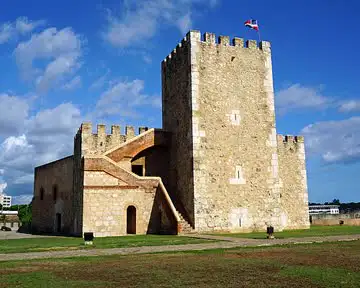
Fortaleza Ozama. (1963 vs 1508) Fortaleza Ozama →
Nearby on the globe

Sources
Updated: 2026-10-14