
The Solomon Islands: landmarks, animals & facts for kids
1 landmark
The Solomon Islands on My Earth Toy, the free 3D toy globe for kids: 1 landmark. Here you can see its flag, capital and size, then fly to every place on the globe.
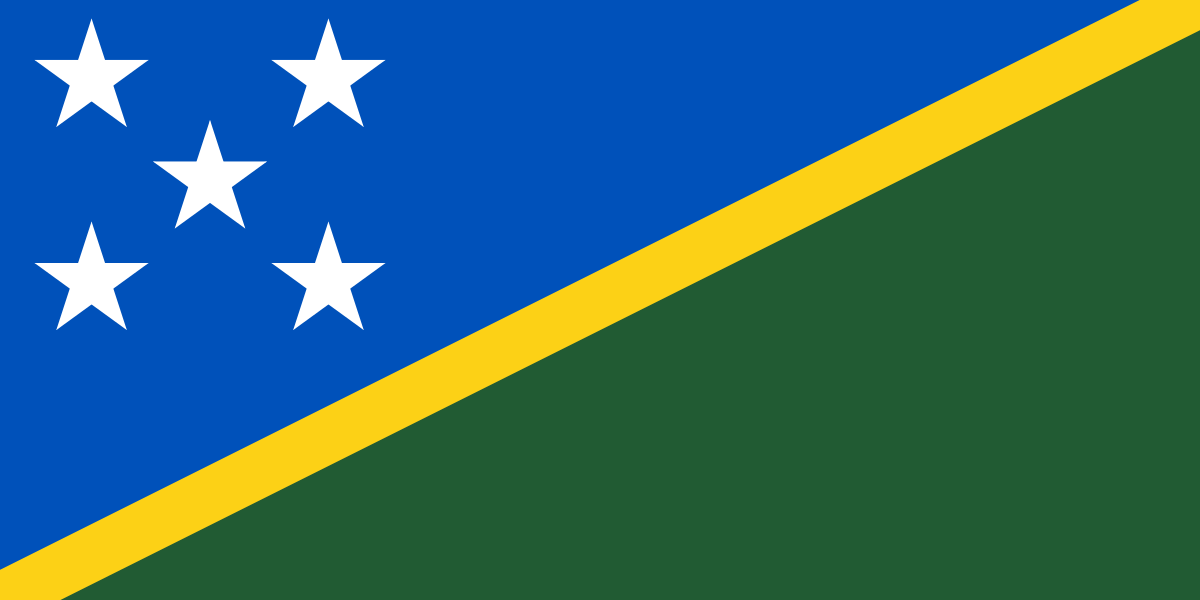
The flag of the Solomon Islands is split by a thin yellow diagonal stripe into a blue triangle at the top, with five white stars, and a green triangle at the bottom.
Read about this flag →the Solomon Islands at a glance
- Capital
- Honiara
- Continent
- Oceania
- Area
- 28,896 km²
- Population
- 0.8 million
Solomon Islands is an island country in the south-western Pacific Ocean, in the region called Melanesia, east of Papua New Guinea and north-east of Australia. It is made up of six large islands and hundreds of smaller ones. The capital, Honiara, is on the island of Guadalcanal.
Solomon Islands is known for its rainforest-covered volcanic islands, huge lagoons, coral reefs and shell money, as well as its role in the Second World War. On the globe you can find the National Parliament of Solomon Islands in Honiara, a round building with a tall, cone-shaped roof on a hill above the city.
Geography and nature
Most of the big islands, such as Guadalcanal, Malaita and New Georgia, are mountainous and covered in thick rainforest, while many small islands are low coral islands. Guadalcanal's Mount Popomanaseu, about 2,300 metres tall, is the highest peak. Marovo Lagoon is one of the largest saltwater lagoons in the world. East Rennell, a raised coral atoll with a big lake, is a UNESCO World Heritage Site. The seas are rich in coral, turtles and dolphins, and the forests hold many birds found nowhere else.
People, languages and culture
English is the official language, but around 70 local languages are spoken, and most people use Solomon Islands Pijin to talk with each other. Almost everyone is Christian. Most people live in villages, fishing and growing taro, sweet potatoes and coconuts. On Malaita, strings of tiny shell beads are still made into traditional shell money, used for bride price and ceremonies. Some people in Lau Lagoon live on artificial islands built from coral rocks. Panpipe bands are a famous musical tradition.
History in a nutshell
People first reached these islands tens of thousands of years ago. In 1568 the Spanish explorer Álvaro de Mendaña arrived, and the islands were later named after the rich King Solomon in hopes of finding gold. Britain made the islands a protectorate in the 1890s. During the Second World War, Guadalcanal saw months of heavy fighting between Allied and Japanese forces in 1942 and 1943. Solomon Islands became independent on 7 July 1978 and is a member of the Commonwealth.
Fun facts
- In 1943 two Solomon Islander scouts, Biuku Gasa and Eroni Kumana, helped rescue the shipwrecked crew of a US boat led by John F. Kennedy, who later became US president.
- Lake Tegano on East Rennell is the largest lake in the islands of the Pacific.
- Shell money from Malaita can take weeks of careful work to make.
- The capital's airport is named Honiara International, but it began as an airfield built during the Second World War.
Famous landmarks in the Solomon Islands
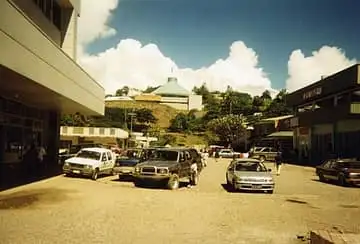
National Parliament of Solomon Islands
Solomon Islands · Oceania
The parliament house of the Solomon Islands stands on a hill above Honiara, crowned by a huge conical roof.
Questions
What is the capital of the Solomon Islands?
The capital of the Solomon Islands is Honiara.
Which continent is the Solomon Islands in?
The Solomon Islands is in Oceania.
How big is the Solomon Islands?
The Solomon Islands covers about 28,896 km².
How many people live in the Solomon Islands?
About 0.8 million people live in the Solomon Islands.
What are the most famous landmarks in the Solomon Islands?
On My Earth Toy's free 3D globe, the landmark from the Solomon Islands is National Parliament of Solomon Islands, with a photo and quick facts.
Sources
Updated: 2026-10-30