
Uruguay: landmarks, animals & facts for kids
1 landmark · 1 animal
Uruguay on My Earth Toy, the free 3D toy globe for kids: 1 landmark, 1 animal. Here you can see its flag, capital and size, then fly to every place on the globe.
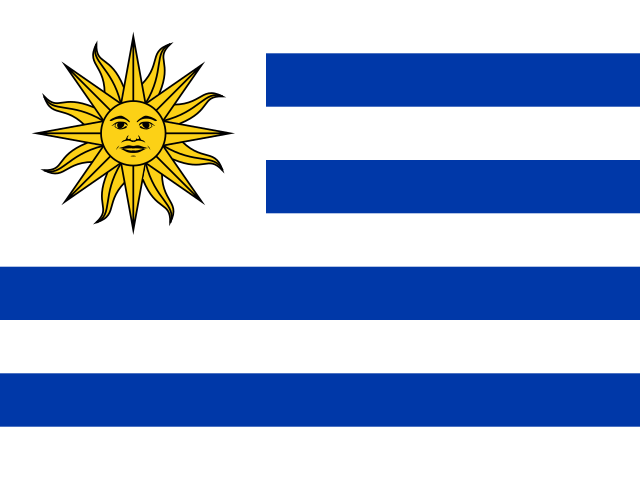
Nine horizontal stripes, white and blue in turn, with a white square in the top left corner holding a golden Sun of May with a face and 16 rays.
Read about this flag →Uruguay at a glance
- Capital
- Montevideo
- Continent
- South America
- Area
- 176,215 km²
- Population
- 3.4 million
Uruguay is a small country in south-eastern South America. It borders Brazil to the north and Argentina to the west, across the Uruguay River, and its southern coast faces the wide Río de la Plata estuary and the Atlantic Ocean. The capital, Montevideo, is home to nearly half of the country's people.
Uruguay is known for its gentle grasslands and cattle ranches, sandy beaches, love of football and the herbal drink mate. On the globe you can find La Mano in Punta del Este, a giant sculpture of fingers rising out of the sand on the beach, and the greater rhea, a large flightless bird of the grasslands.
Geography and nature
Uruguay is mostly low, rolling grassland with a mild climate; its highest point, Cerro Catedral, is only about 514 metres. Rivers and streams cross the countryside, and wetlands and lagoons line the Atlantic coast. The country has long sandy beaches, especially around Punta del Este. Grasslands are home to the greater rhea, capybaras and many birds, and southern right whales and sea lions visit the coast. Much of the land is used for raising cattle and sheep.
People, languages and culture
Spanish is the official language. Most Uruguayans have European ancestry, especially Spanish and Italian, and there are Afro-Uruguayan communities whose candombe drumming is listed by UNESCO. Many people carry a gourd of mate and a flask of hot water all day long. Asado, beef grilled over wood embers, is a weekend tradition, and the chivito is a famous steak sandwich. Tango is shared with Argentina. Football is a national passion, and Uruguay has won the World Cup twice.
History in a nutshell
The Charrúa and other Indigenous peoples lived here before Europeans arrived. Spain and Portugal competed for the land: the Portuguese founded Colonia del Sacramento in 1680, and the Spanish founded Montevideo in the 1720s. José Gervasio Artigas led an early fight for independence and is honoured as the national hero. Uruguay became an independent country in 1828. It suffered a military dictatorship from 1973 to 1985 and has been a democracy since then.
Fun facts
- Uruguay hosted and won the very first FIFA World Cup in 1930.
- Uruguay has around three to four cattle for every person, one of the highest ratios in the world.
- La Mano, made by the Chilean artist Mario Irarrázabal in 1982, is also known as the Monument to the Drowned.
- The old town of Colonia del Sacramento, with its cobbled streets, is a UNESCO World Heritage Site.
Famous landmarks in Uruguay
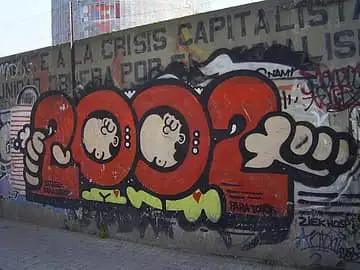
La Mano (Punta del Este)
Uruguay · South America
A giant sculpture of five fingers rising from the beach sand, the emblem of Punta del Este.
Animals in Uruguay
Questions
What is the capital of Uruguay?
The capital of Uruguay is Montevideo.
Which continent is Uruguay in?
Uruguay is in South America.
How big is Uruguay?
Uruguay covers about 176,215 km².
How many people live in Uruguay?
About 3.4 million people live in Uruguay.
What are the most famous landmarks in Uruguay?
On My Earth Toy's free 3D globe, the landmark from Uruguay is La Mano (Punta del Este), with a photo and quick facts.
Which animals can you find in Uruguay on My Earth Toy?
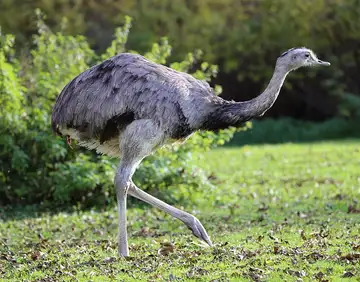
On the globe you can find Greater rhea in Uruguay.
Sources
Updated: 2026-10-30