
Greater rhea
레아
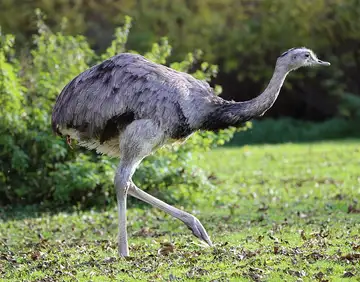
A large flightless bird of South American grasslands, standing up to about 1.5 m tall. It can run at roughly 60 km/h, and the male builds the nest and incubates the eggs.
See it on the 3D globe →At a glance
- Class
- Birds
- Lives in
- Pampas of Argentina
- Diet
- Eats both plants and meat (omnivore)
- Weight
- about 25 kg
- Top speed
- about 60 km/h
- Conservation status
- Near Threatened (IUCN NT)
- Habitat
- grasslands, savannas
Quick answers
Where does the Greater rhea live?
It lives in grasslands, savannas. On the globe you can find it near Pampas of Argentina.
How big is the Greater rhea?
It grows to about 25 kg.
What does the Greater rhea eat?
Its diet: eats both plants and meat (omnivore).
How fast is the Greater rhea?
It can reach about 60 km/h.
Is the Greater rhea endangered?
It is listed as Near Threatened (IUCN NT).
The greater rhea is a large bird that cannot fly. It lives in grasslands, savanna and grassy wetlands of eastern South America, and it is the largest native bird in the Americas. An adult weighs 20 to 27 kilograms and stands about 1.5 metres tall, with a long neck and long legs. Its Spanish name is ñandú.
Rheas live in groups and can run fast, around 60 kilometres per hour, stretching out their necks and using one wing like a rudder to turn. They eat plants, insects and small animals. The IUCN lists the greater rhea as Near Threatened. A wild rhea lives about 10 years on average. The globe places it on the pampas of Argentina.
Fathers do the nest work
Among rheas the father takes charge. He builds the nest, a shallow hollow in the ground, and several females may lay their eggs in it, so one nest can hold 30 or more eggs. The male sits on the eggs until they hatch and then looks after the chicks. The young grow quickly and reach adult size in about five months.
Family and surprises
The greater rhea belongs to the same group of flightless birds as the ostrich, emu, cassowary and kiwi. Its genus is named after Rhea, a Greek goddess. There are five subspecies that look very much alike. In the 2000s and 2010s, some rheas that escaped from farms in northern Germany formed a wild population there. The species was formally described in 1758 by Carl Linnaeus.
Fun facts
- The father alone guards the nest, which can hold eggs laid by several different females.
- A single rhea nest may hold eggs laid by several different females.
- Rheas can run at roughly 60 kilometres per hour.
- A wild population of greater rheas has become established in northern Germany.
On the globe
The globe places the rhea on the pampas of Argentina. Look for the long neck, long legs and the large grey-brown body.
Quiz time
Which is heavier: Greater rhea or Andean condor?
Show the answer
Greater rhea. (25 kg vs 11 kg) Andean condor →
More like this



Sources
Updated: 2026-10-14