
Famous landmarks in Uzbekistan
4 landmarks
Uzbekistan on My Earth Toy, the free 3D toy globe for kids: 4 landmarks. Here you can see its flag, capital and size, then fly to every place on the globe.
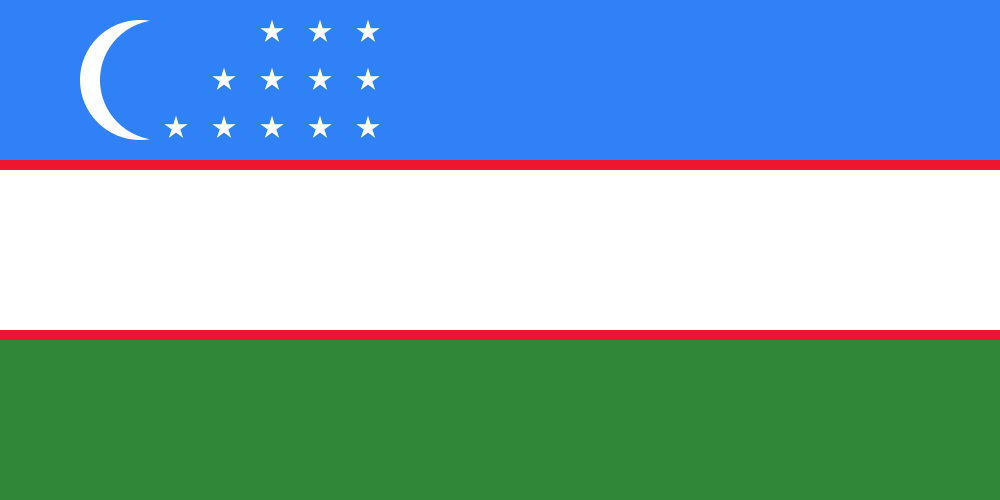
Three horizontal stripes of light blue, white and green, separated by two thin red lines, with a white crescent moon and twelve white stars in the top left corner.
Read about this flag →Uzbekistan at a glance
- Capital
- Tashkent
- Continent
- Asia
- Area
- 448,978 km²
- Population
- 36.4 million
Uzbekistan is a country in Central Asia. It borders Kazakhstan, Kyrgyzstan, Tajikistan, Afghanistan and Turkmenistan, and it is doubly landlocked: none of its neighbours touches the ocean either. Only one other country in the world, Liechtenstein, is like this. The capital, Tashkent, is the largest city in Central Asia.
Uzbekistan is famous for the Silk Road cities of Samarkand, Bukhara and Khiva, with their blue-tiled domes and minarets. On the globe you can find the Registan in Samarkand, three grand madrasas around a square, the Gur-e-Amir, the tomb of the conqueror Timur, the Ark fortress of Bukhara and Itchan Kala, the walled old town of Khiva.
Geography and nature
Much of Uzbekistan is flat desert, especially the Kyzylkum, or 'Red Sand', Desert. In the east, the land rises to the foothills of the Tian Shan mountains and the green, fertile Fergana Valley, where many people live. Two great rivers, the Amu Darya and the Syr Darya, once filled the Aral Sea, but so much water has been taken for farming, especially cotton, that the sea has shrunk dramatically since the 1960s. Summers are hot and dry, and winters can be cold.
People, languages and culture
People speak Uzbek, a Turkic language, officially written in Latin letters, and Russian is also used, along with Tajik in Samarkand and Bukhara. Most people are Muslim. Plov, rice cooked with meat, carrots and onions in a huge pot, is the national dish, and its tradition is listed by UNESCO. Round non bread is stamped with patterns. Uzbekistan is famous for crafts such as suzani embroidery, ikat silk from Margilan and blue ceramics. Guests are always offered tea first.
History in a nutshell
Thousands of years ago, the region was home to Sogdiana and Khwarazm, and Alexander the Great passed through. Silk Road caravans made Samarkand and Bukhara rich. Arab armies brought Islam in the 700s, and scholars such as al-Khwarizmi and Ibn Sina came from these lands. Genghis Khan's Mongols destroyed many cities in 1220, but in the 1300s Timur built a great empire with Samarkand as its glittering capital. Later came the khanates of Bukhara, Khiva and Kokand, then Russian and Soviet rule. Uzbekistan became independent in 1991.
Fun facts
- The word 'algorithm' comes from the name of al-Khwarizmi, a mathematician from the Khwarazm region in today's Uzbekistan.
- Timur's grandson Ulugh Beg built a huge observatory in Samarkand in the 1420s to study the stars.
- Itchan Kala in Khiva was the first place in Central Asia to become a UNESCO World Heritage Site.
- The Registan's three madrasas were built over more than 200 years, from the 1400s to the 1600s.
Famous landmarks in Uzbekistan
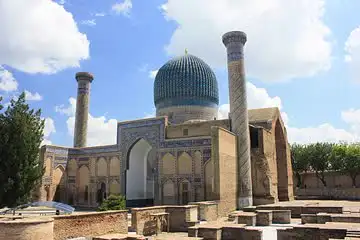
Gur-e-Amir
Uzbekistan · Asia
The mausoleum of Timur, crowned by a ribbed turquoise dome on a tall drum banded with giant Kufic script.
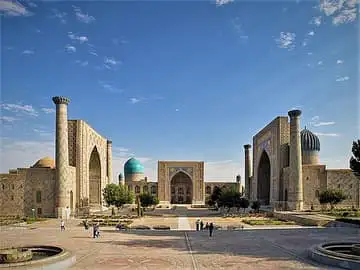
Registan, Samarkand
Uzbekistan · Asia
Samarkand's grand square, framed by three madrasas covered in dazzling blue tilework.
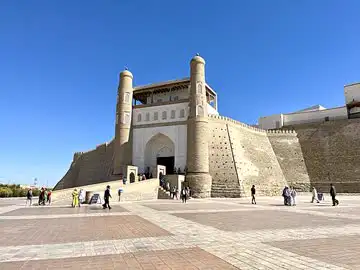
Ark of Bukhara
Uzbekistan · Asia
The massive mud-brick fortress of Bukhara’s rulers, entered by a ramp between two tapering gate towers.
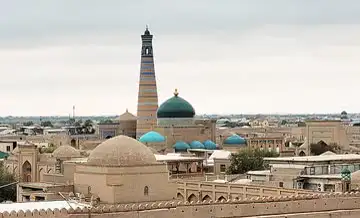
Itchan Kala
Uzbekistan · Asia
Khiva’s walled inner town, with the stubby tiled Kalta Minor and the slender Islam Khodja minaret.
Questions
What is the capital of Uzbekistan?
The capital of Uzbekistan is Tashkent.
Which continent is Uzbekistan in?
Uzbekistan is in Asia.
How big is Uzbekistan?
Uzbekistan covers about 448,978 km².
How many people live in Uzbekistan?
About 36.4 million people live in Uzbekistan.
What are the most famous landmarks in Uzbekistan?
Some of the best-known landmarks in Uzbekistan are Gur-e-Amir, Registan, Samarkand, Ark of Bukhara and Itchan Kala. My Earth Toy has 4 landmarks from Uzbekistan on its free 3D globe, each with a photo and quick facts.
Sources
Updated: 2026-10-30