
Batagaika crater
바타가이카 분화구 (지옥의 문)
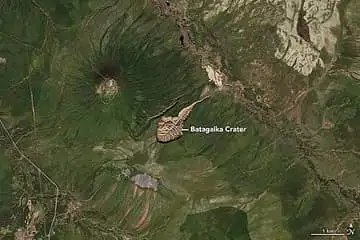
In the Verkhoyansk Range of Sakha (Yakutia), Russia, this is one of the largest permafrost thaw slumps on Earth: about 1 km long, with a headwall up to roughly 100 m high. It began collapsing after the forest was cleared and the ice-rich ground started to thaw, and it keeps eating backwards every year. Its striped walls expose ground ice and layers laid down over hundreds of thousands of years, and locals call it the gateway to the underworld.
See it on the 3D globe →At a glance
- Country
- Russia
- Kind
- Mysteries
Quick answers
Where is Batagaika crater?
Batagaika crater is in Russia.
The Batagaika crater, also spelled Batagay, is a giant gash in the ground in the Sakha Republic of Siberia, Russia. It is the largest known permafrost crater in the world. The hollow is about one kilometre long and up to 100 metres deep, and it is still growing.
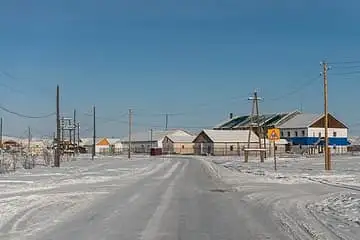
It is not a volcano or an impact crater. It is a thermokarst depression, which forms when ice-rich frozen ground thaws and collapses. The land began to sink in the 1960s after the surrounding forest was cleared, and floods have helped widen it. The crater sits about 10 kilometres southeast of the town of Batagay, around 660 kilometres north-northeast of Yakutsk.
Why it keeps growing
Permafrost is soil that stays frozen all year. When the top layer is exposed, the ice inside melts and the ground slumps, which exposes even more frozen soil to the air.
Scientists say the crater will probably keep eating into the hillslope. Every year, as soon as the weather warms above freezing, the process starts again. By 2016, the headwall was retreating more than 10 metres a year, sometimes up to 30.
What scientists find there
The crater's steep walls show layers of ground that froze long ago. Paleontologists have found Ice Age fossils buried in the mud around the rim.
The rim is very unstable, with frequent landslides, so it is dangerous to approach. Researchers study it to learn how the climate of the past and the thawing ground fit together.
Fun facts
- This giant gash in thawing permafrost began forming in the 1960s after forest was cleared, and it is still growing every year.
- By 2016 the crater had melted over 25 million cubic metres of ice-rich frozen ground.
- The headwall can retreat 10 to 30 metres in a single year.
- Ice Age fossils have been found in the mud around its rim.
On the globe
The model shows the raw, steep-walled gash in the Siberian forest where permafrost has melted away.
Nearby on the globe

Sources
Updated: 2026-10-14