
Tunguska event
퉁구스카 대폭발
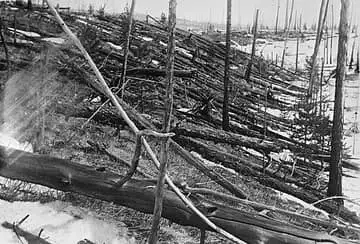
On the morning of 30 June 1908, an asteroid or comet fragment some 50–60 m across exploded in the sky above the Podkamennaya Tunguska River in Siberia before it could reach the ground. The blast flattened about 80 million trees over 2,150 km² of forest, yet left no crater. When scientist Leonid Kulik arrived in 1927, he found the fallen trees all pointing away from the centre, while at the centre itself dead trunks still stood upright, stripped of their branches.
See it on the 3D globe →At a glance
- Country
- Russia
- Kind
- Mysteries
Quick answers
Where is Tunguska event?
Tunguska event is in Russia.
On the morning of 30 June 1908, a huge explosion shook a remote, forested part of Central Siberia, near the Podkamennaya Tunguska River. It knocked witnesses to the ground and broke windows up to 200 kilometres away.
Scientists think a rock from space, probably 50 to 60 metres wide, blew up in the air five to ten kilometres above the ground. It flattened trees over about 2,150 square kilometres, yet left no crater. It is the largest impact-related event in recorded history. Because it happened over a forest and not a city, almost nobody was hurt, but over a big city it would have been a disaster.
What happened?
The blast was recorded by seismic stations in Russia and Germany, and for several nights afterwards the skies over western Eurasia glowed unusually bright. At least three people died. Because the area was so remote, the first scientific expedition arrived only in 1921, led by Leonid Kulik, and he found the centre in 1927. The trees had fallen outward in a pattern pointing away from the middle.
What do scientists think caused it?
Most researchers favour an air burst: a meteoroid broke apart high above the ground and released energy of about 10 to 15 megatons of TNT. Whether it was a stony asteroid or an icy comet is still debated, and no clear fragment has been identified. Other ideas, such as a gas explosion underground, are not widely accepted. The Chelyabinsk meteor of 2013 behaved in a similar way, which supports the air-burst idea.
Fun facts
- About 80 million trees were knocked flat, yet no crater has been found.
- The air blast was strong enough to shatter windows 200 kilometres away.
- Lake Cheko, 8 kilometres from the centre, may be a small crater from a fragment, though studies disagree.
On the globe
The model shows the flattened forest, with fallen trunks pointing away from the centre and bare standing trunks in the middle.
Nearby on the globe



Sources
Updated: 2026-10-14