
Blood Falls
블러드 폭포
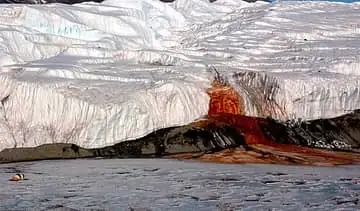
At the snout of Taylor Glacier in Antarctica's McMurdo Dry Valleys, blood-red water seeps out of the ice. Salty brine trapped beneath the glacier is full of dissolved iron, which rusts red the moment it meets the air. The brine is several times saltier than seawater, so it stays liquid below freezing, and microbes live in it with no light and almost no oxygen.
See it on the 3D globe →At a glance
- Country
- Antarctica
- Type
- Waterfall
- Kind
- Mysteries
Quick answers
Where is Blood Falls?
Blood Falls is in Antarctica.
Blood Falls is a blood-red stream of salty water that flows out of the Taylor Glacier onto the frozen surface of West Lake Bonney, in the Taylor Valley of the McMurdo Dry Valleys in East Antarctica. Against the white ice, the red color looks dramatic, but it is not blood.
The red color is from iron oxide, which is basically rust. Iron-rich water that is very salty seeps out from small cracks in the ice. The water has been trapped under about 400 metres of glacier ice, in a pool of unknown size. Once it meets the air, the iron rusts and turns red.
Who found it
Australian geologist Thomas Griffith Taylor discovered the red stain in 1911, when he first explored the valley that now bears his name.
Early Antarctic explorers thought the color came from red algae, since algae can stain snow red. Later tests proved that it came from iron oxides instead, so the 'blood' is really mineral rust carried in very salty water.
Ancient seawater under the ice
The salty water seems to be old seawater, trapped when a fjord was cut off by the advancing glacier millions of years ago, during the Miocene, about 5 million years ago.
As the water froze slowly, ice crystals left the salt behind, so the leftover brine became two to three times saltier than the ocean. Because of the salt, the water stays liquid in the cold, and the glacier is not frozen to the rock beneath it.
Fun facts
- Its red colour comes from salty, iron-rich water that rusts when it meets the air, not from blood.
- The red color is from rust, not blood or algae.
- The salty water is two to three times saltier than seawater.
- It was found in 1911 by geologist Thomas Griffith Taylor.
On the globe
The model shows a glacier tongue with a blood-red stream pouring onto the ice in Antarctica.
Nearby on the globe

Sources
Updated: 2026-10-14