
McMurdo Station
맥머도 기지
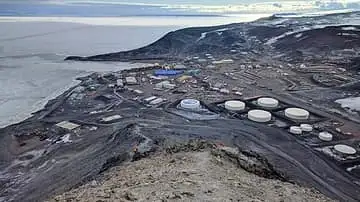
Antarctica’s largest base, a US research and logistics hub housing over 1,000 people in summer; Observation Hill behind it bears a cross for Scott’s party.
See it on the 3D globe →At a glance
- Country
- Antarctica
- Location
- Ross Island, Antarctica
- Built
- 1956
Quick answers
Where is McMurdo Station?
McMurdo Station is in Ross Island, Antarctica.
When was McMurdo Station built?
McMurdo Station was built in 1956.
McMurdo Station is a United States research base on Ross Island in Antarctica. It is the largest station on the whole continent and the main supply hub for the U.S. Antarctic Program, run by the National Science Foundation. The station sits on dark volcanic rock at the southern tip of Ross Island, the farthest south that ships can reach, and about 40 kilometres from Mount Erebus, the world's southernmost active volcano.
In the busy summer season, up to about 1,100 people can live at McMurdo in a single week, while in the dark winter there are only about 200 or fewer. They include scientists, pilots, cooks, mechanics and many other workers who keep the station running. People and cargo heading to the U.S. station at the South Pole usually pass through McMurdo first, by plane or by a long snow road across the ice.
History
The area was first charted in 1841 by James Clark Ross, and the station takes its name from McMurdo Sound, named after Lieutenant Archibald McMurdo of the ship HMS Terror. In 1902 the British explorer Robert Falcon Scott built a wooden cabin here, called Discovery Hut, which still stands at Hut Point. The United States set up its base in December 1955 and opened it in 1956 for the International Geophysical Year, a worldwide science project. It was first run by the U.S. Navy, which handed it to the National Science Foundation in 1993.
Life on the ice
McMurdo looks like a small town, with about 146 buildings: dormitories, workshops, a fire station, a power plant, a library, a coffee house, gyms and a large science centre with laboratories and a saltwater aquarium. Fresh water is made from seawater, and electricity comes from generators helped by wind turbines shared with New Zealand's nearby Scott Base. Every year a cargo ship brings millions of litres of fuel and supplies, often needing an icebreaker to clear a path. Temperatures range from about 8 °C in summer to as low as minus 50 °C in winter.
Observation Hill
Behind the station rises Observation Hill, a 230-metre-high volcanic hill that people climb for the view. On its top stands a wooden cross put up in January 1913 in memory of Captain Scott and the men of his party who died on the way back from the South Pole in 1912. It is carved with a line from a poem by Alfred Tennyson: 'To strive, to seek, to find, and not to yield.' The memorial is now a protected historic site under the Antarctic Treaty.
Fun facts
- It sits on Ross Island, home of the active volcano Mount Erebus.
- McMurdo serves about 148,000 meals a year.
- From 1962 to 1972 the station ran on a small nuclear power plant, which also helped turn seawater into drinking water.
- The station keeps New Zealand time, because almost all flights to McMurdo leave from Christchurch.
- The wind turbines near McMurdo form the southernmost wind farm on Earth.
- Scott's Discovery Hut from 1902 still stands at the water's edge next to the station.
On the globe
The model shows Antarctica's largest base on Ross Island, with Observation Hill and its memorial cross for Scott's party behind it. Zoom in to find the cross on top of the hill.
Nearby on the globe

Sources
- Read more on Wikipedia
- McMurdo Station — Wikipedia
- 맥머도 기지 — 위키백과
- NSF McMurdo Station — U.S. National Science Foundation, Office of Polar Programs
- Observation Hill (McMurdo Station) — Wikipedia
Updated: 2026-10-13