
Chicxulub crater
칙술루브 충돌구
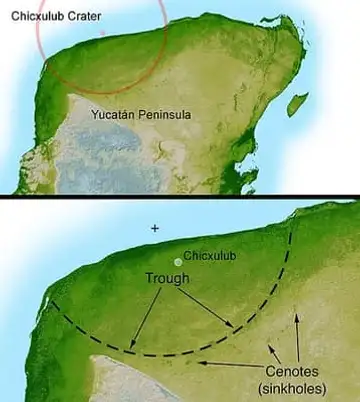
Buried under Mexico's Yucatán Peninsula lies an impact crater about 180 km wide, made some 66 million years ago when an asteroid roughly 10 km across struck the Earth. The impact changed the world's climate so much that it is thought to have wiped out the dinosaurs (except birds). The crater is hidden under thick limestone, but a curved "Ring of Cenotes" — natural sinkhole wells along its rim — still traces its outline.
See it on the 3D globe →At a glance
- Country
- Mexico
- Kind
- History
Quick answers
Where is Chicxulub crater?
Chicxulub crater is in Mexico.
The Chicxulub crater is a giant impact crater buried under the Yucatán Peninsula in Mexico. It was made a little over 66 million years ago when an asteroid about ten kilometres wide hit Earth.
The crater is roughly 200 kilometres across and lies about a kilometre below younger rocks. Scientists now widely accept that the impact and its climate effects were the main cause of the mass extinction that ended the age of the non-bird dinosaurs. Because the crater is buried, you cannot see it from a window; it was found by studying gravity and rocks. It is one of the largest impact structures on Earth.
How was it discovered?
In the late 1970s, geologist Walter Alvarez and his father, physicist Luis Alvarez, found a thin clay layer rich in iridium, an element rare on Earth but common in asteroids. They argued it was dust from a huge impact.
Around the same time, geophysicists Antonio Camargo and Glen Penfield, searching for oil in Yucatán, noticed a strange circular structure. In 1990 Penfield received rock samples that showed it was an impact crater, matching the Alvarez idea.
What did the impact do?
The impact date matches the end of the Cretaceous period, when about 75 per cent of plant and animal species disappeared, including all dinosaurs except birds.
Evidence includes shocked quartz, a gravity anomaly and glassy droplets called tektites in surrounding areas. The crater is also special because its peak ring, a ring of hills made during the impact, is intact and can be studied.
Fun facts
- The asteroid that made this crater about 66 million years ago is linked to the extinction of the dinosaurs.
- The asteroid was about ten kilometres (six miles) wide.
- The crater is named after the village of Chicxulub Pueblo.
- About 75 per cent of species died out around the time of the impact.
On the globe
Find it on the globe on Mexico's Yucatán Peninsula and zoom in to open its card.
Nearby on the globe


Sources
Updated: 2026-10-14