
Great Blue Hole
그레이트 블루홀
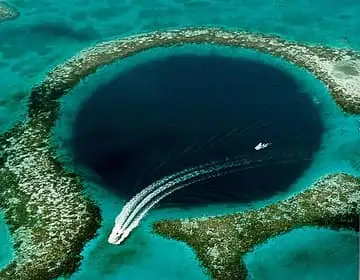
The Great Blue Hole is a giant round marine sinkhole off the coast of Belize, near the middle of Lighthouse Reef, a small ring-shaped coral island (atoll) about 70 kilometres from the mainland. It measures 318 metres across and about 124 metres deep. The hole covers about 70,000 square metres.
See it on the 3D globe →At a glance
- Country
- Belize
- Location
- Lighthouse Reef, Belize
- Built
- natural
Quick answers
Where is Great Blue Hole?
Great Blue Hole is in Lighthouse Reef, Belize.
A round marine sinkhole about 300 m across and over 120 m deep, a striking dark-blue circle in the middle of the turquoise Lighthouse Reef.
From above it looks like a dark-blue eye in the turquoise water of the reef. It is part of the Belize Barrier Reef Reserve System, a UNESCO World Heritage Site, and it is a famous place for scuba diving. Jacques Cousteau explored it in 1971, and in 2012 Discovery Channel ranked it first among the ten most amazing places on Earth.
How did it form?
It began as a limestone cave system on dry land, when sea levels were much lower during the ice ages. Stalactites found in it show that it formed in several stages, about 153,000, 66,000, 60,000 and 15,000 years ago. When the oceans rose again, the cave flooded and its roof collapsed.
Ledges inside lie at depths of about 21, 49 and 91 metres.
Exploring it
Jacques Cousteau made the site famous in 1971, when he brought his ship, the Calypso, to chart its depths and called it one of the best dive sites in the world.
In December 2018 two submarines descended to map its interior with sonar. They found a layer of hydrogen sulfide at about 91 metres, below which the water is dark and has no oxygen.
What lives around it
The rim of the hole is a living reef. It is only about 5 metres deep at the edge, then slopes down to about 10 metres before dropping away as a nearly straight cliff. Groupers, squirrelfish, angelfish, butterflyfish and midnight parrotfish live here, along with reef sharks such as nurse sharks, Caribbean reef sharks and blacktip sharks. Sea anemones, cleaner shrimp and tiny neon gobies are found too. Deeper in the hole, below the hydrogen-sulfide layer, the water has no oxygen and is not home to any life. Discovery Channel ranked the site first on its list of the ten most amazing places on Earth in 2012.
Fun facts
- It is almost a perfect circle, 318 metres across.
- Jacques Cousteau explored it in 1971 with his ship Calypso.
- Stalactites inside prove it was once a dry cave.
- Below about 91 metres, the water has no oxygen and is full of hydrogen sulfide.
On the globe
The model shows a round dark-blue hole in the middle of the shallow turquoise reef.
Nearby on the globe

Sources
Updated: 2026-10-14