
Giant's Causeway
자이언츠 코즈웨이
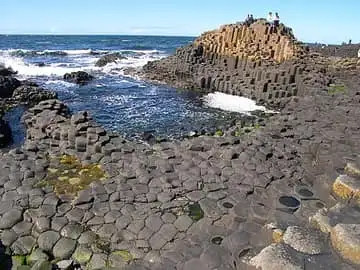
On the coast of Northern Ireland, about 40,000 mostly six-sided stone columns step down into the sea like a giant staircase. They formed 50 to 60 million years ago when a thick lava flow cooled slowly and cracked into regular columns, the way drying mud cracks into polygons. Legend says the giant Finn McCool built it as a causeway to reach Scotland.
See it on the 3D globe →At a glance
- Country
- United Kingdom
- Kind
- Mysteries
Quick answers
Where is Giant's Causeway?
Giant's Causeway is in United Kingdom.
The Giant's Causeway is an area of about 40,000 interlocking stone columns on the north coast of Northern Ireland, in County Antrim, around five kilometres northeast of the village of Bushmills. The columns are made of basalt, a dark volcanic rock.
UNESCO named it a World Heritage Site in 1986. It is one of Northern Ireland's most popular attractions, with nearly a million visitors in 2019, and access to the stones is free. The National Trust looks after much of the site. A visitor centre charges a fee, but walking to the stones is free. It is also a national nature reserve, declared in 1987.
How did it form?
About 50 to 60 million years ago, Antrim had intense volcanic activity, and very runny molten basalt pushed up through chalk. As the lava cooled it shrank and cracked, rather like drying mud, and the cracks grew downward to form tall pillars.
Most columns have six sides, though some have four to eight. The tallest are about 12 metres high, and the lava in the cliffs is up to 28 metres thick. In 2022 the area was added to a list of 100 geological heritage sites.
The legend of Finn McCool
According to legend, the Irish giant Fionn mac Cumhaill, or Finn McCool, built the causeway as a path across the sea to Scotland to fight a rival giant.
It is a story, not science, but it fits the look of the place: the tops of the columns form stepping stones that lead from the cliff foot and disappear under the sea.
Fun facts
- There are around 40,000 columns, and the tallest are about 12 metres.
- Most columns are hexagonal, but some have four to eight sides.
- The Irish name is Clochán an Aifir.
On the globe
Find it on the globe on the north coast of Northern Ireland and zoom in to open its card.
Nearby on the globe

Sources
Updated: 2026-10-14