
Lake Baikal (Shaman Rock)
바이칼호 (샤먼 바위)
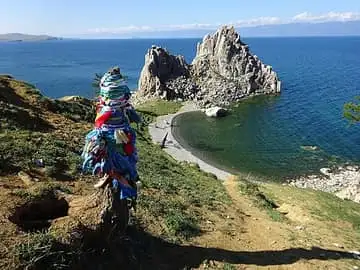
The deepest lake on Earth (1,642 m) and the oldest (about 25 million years), holding roughly a fifth of the world's unfrozen surface fresh water. Twin-peaked Shaman Rock on Olkhon Island is Baikal's most sacred site.
See it on the 3D globe →At a glance
- Country
- Russia
Quick answers
Where is Lake Baikal (Shaman Rock)?
Lake Baikal (Shaman Rock) is in Russia.
Lake Baikal is a rift lake in southern Siberia, Russia, between Irkutsk Oblast and the Republic of Buryatia. It is the deepest lake in the world, reaching 1,642 metres, and the oldest, at an estimated 25 to 30 million years. Because it is so deep, it holds more fresh water than any other lake, about 22 to 23 percent of the world's fresh surface water, more than all five North American Great Lakes combined.
The lake is 636 kilometres long and up to 79 kilometres wide, with a surface area of about 31,700 square kilometres, slightly larger than Belgium. It is one of the clearest lakes on Earth. UNESCO made it a World Heritage Site in 1996. The globe shows it with its shoreline and Shaman Rock, a famous spot on Olkhon Island, the lake's largest island.
A lake in a rift
Baikal sits in a rift valley where Earth's crust is slowly pulling apart. The rift is young and active, widening about 4 millimetres a year, and earthquakes strike every few years. Hot springs bubble up in the area.
The lake is split into North, Central and South basins, with depths of about 900, 1,600 and 1,400 metres. Its bottom lies about 1,186 metres below sea level, with roughly 7 kilometres of sediment beneath that.
Clear water and thick ice
In winter, the water in open parts can be clear down to 30 or 40 metres, and Baikal stays rich in oxygen even in its deep layers. From early January until May or June the surface freezes, with ice about half a metre to 1.4 metres thick.
The lake is fed by as many as 330 rivers but drains through only one, the Angara. Storms are common in summer and autumn, with waves up to 4.5 metres. Average surface temperature has risen by almost 1.5 degrees Celsius in the last 50 years.
Life by the lake
Baikal is home to more than 1,000 plant species and about 2,500 animal species known so far, and the real numbers are believed to be higher. Many live nowhere else, including fish such as the omul and the Baikal seal, called the nerpa.
The lake has 27 islands. Olkhon is 72 kilometres long, the third-largest island in any lake in the world. On the eastern side the Buryat people raise goats, camels, cattle, sheep and horses.
Fun facts
- Baikal holds more fresh water than all of North America's Great Lakes combined, about a fifth of the world's unfrozen fresh surface water.
- Baikal holds more fresh water than all five North American Great Lakes put together.
- The lake is slightly larger in area than Belgium.
- About 19 percent of the unfrozen fresh water on the planet is estimated to be in Baikal.
- Its sediments were never scraped away by ice sheets, so cores drilled from them record climate changes of the past 6.7 million years.
On the globe
The model shows the huge lake with its shoreline and the famous Shaman Rock in Siberia.
Nearby on the globe



Sources
Updated: 2026-10-14