
Luna 2’s pennants
루나 2호의 페넌트
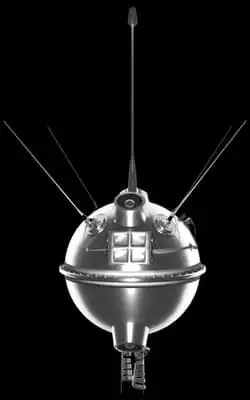
In 1959 the Soviet Luna 2 became the first human-made object to reach the Moon. It carried two metal balls made of pentagon-shaped pieces, designed to burst and scatter them on impact, and a strip pennant.
See it on the 3D Moon →At a glance
- Where
- East of the Sea of Rains · first impact
- 📅 Impact
- 1959-09-14
- 🚀 Sent by
- Soviet Union
- Coordinates
- 29.10°N 0.00°E
- Kind
- Hidden finds
Luna 2 was a Soviet space probe that became the first human-made object to reach the Moon, and the first to reach any other world. It launched on 12 September 1959, less than two years after Sputnik 1, the first satellite. About a day and a half later it crashed into the Moon east of the Sea of Rains, near the craters Archimedes, Aristides and Autolycus.
Luna 2 did not try to land gently. It flew straight at the Moon and hit it at about 3.3 km per second, about 12,000 km per hour. Before the crash its instruments sent back useful measurements, and it carried metal pennants, small badges of the Soviet Union, meant to scatter across the surface as a sign that the country had got there first.
The mission
Luna 2 left from Baikonur on a Luna 8K72 rocket and took a direct path to the Moon instead of going into orbit first. Together with the last stage of its rocket it weighed about 390 kg. The impact came on 13 September 1959 by world time, which was just after midnight on 14 September in Moscow. Along the way, it released a glowing cloud of sodium gas about 650 km wide so that observatories in the Soviet Union could follow it.
The pennants
The probe carried two balls made of 72 five-sided pieces of titanium alloy. The piece in the middle carried the Soviet emblem and the letters for USSR. The balls were designed to burst just before impact and throw their pieces in every direction. A third pennant, made of aluminium strips, rode on the rocket's last stage. Soviet leader Nikita Khrushchev later gave US President Dwight Eisenhower a copy of the pennant ball as a gift.
What scientists found
Luna 2's instruments found that the Moon has no strong magnetic field and no belts of trapped radiation like the ones around Earth. It also made the first direct measurement of the solar wind, the stream of particles flowing out from the Sun, from outside Earth's protective magnetic bubble. Each finding came from just a day and a half of flying, and the probe stopped sending signals at the moment it hit the Moon.
Fun facts
- Luna 2 hit the Moon less than two years after the first satellite was launched.
- It was the first human-made object ever to touch another world.
- Its pennant balls were built to burst and scatter five-sided badges.
- A copy of the pennant ball was given as a gift to the US president.
On the 3D Moon
On the 3D Moon you can find Luna 2's pennants hidden at the first impact site east of the Sea of Rains, where the probe and its pennant balls of pentagon-shaped pieces struck in 1959.
More on the Moon

Sources
Updated: 2026-10-19