
Water bears and Beresheet
물곰과 베레시트
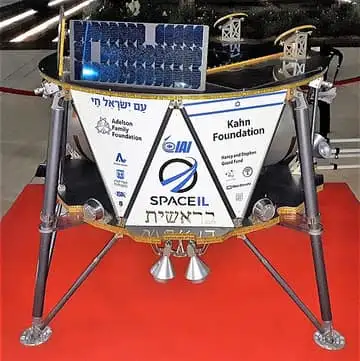
In 2019 the small Israeli lander Beresheet crashed while landing. On board were thousands of dried-out tardigrades (water bears) — animals that survive freezing and drying — so people wondered if some might still be alive.
See it on the 3D Moon →At a glance
- Where
- Sea of Serenity · crash site
- 📅 Impact
- 2019-04-11
- 🚀 Sent by
- SpaceIL (Israel)
- 🐻 Water bear
- About 0.5 mm long
- Coordinates
- 32.60°N 19.35°E
- Kind
- Hidden finds
Beresheet was a small Israeli spacecraft that tried to land on the Moon in 2019. Its name is the Hebrew word for 'in the beginning'. It was built by the Israeli group SpaceIL together with Israel Aerospace Industries, and it was the first Moon landing attempt started by a private organisation. It launched on 22 February 2019 as an extra passenger on a SpaceX Falcon 9 rocket.
On 11 April 2019, during its landing in the Sea of Serenity (Mare Serenitatis), a fault shut off its main engine and the lander crashed. Hidden on board was a tiny 'lunar library' about the size of a DVD, and tucked inside it were a few thousand dried-out tardigrades, also called water bears. That surprise passenger made people around the world ask: could animals be lying on the Moon, still alive?
What happened
Beresheet stood about 1.5 m tall and weighed about 585 kg with fuel. Its engine fired four times to stretch its orbit until it reached lunar orbit on 4 April. As it came down, a gyroscope-like sensor failed, and while the computer restarted, the main engine switched off. The lander hit the ground at more than 500 km/h. Eleven days later NASA's LRO photographed the spot and found a dark smudge about 10 m across, but no clear crater.
The water bears
Tardigrades are tiny animals, usually about half a millimetre long, with eight stubby legs. When they dry out they curl into a ball called a tun and stop almost all their body processes. In that state they can survive deep cold, airlessness and radiation; in a 2007 experiment a few even survived ten days exposed to open space. The ones on Beresheet were dried and sealed in resin between thin metal layers of the lunar library, which also held about 30 million pages of information and some human DNA.
What scientists think
In 2021, scientists at the University of Kent fired frozen, dried tardigrades from a special gun into sand. The animals survived hits up to about 900 m/s, but stronger shocks killed them. Their results suggest that the hard Beresheet crash was most likely too violent for the water bears to survive. Even if some did, the Moon has no air or liquid water, so they could never wake up there on their own.
Fun facts
- Beresheet carried a lunar library about the size of a DVD, holding around 30 million pages of information.
- A few thousand dried-out tardigrades were added to Beresheet's library as a last-minute extra.
- Dried tardigrades in lab tests survived being shot into sand at around 900 metres per second.
- Just before the crash, Beresheet took a selfie showing itself against the Moon.
On the 3D Moon
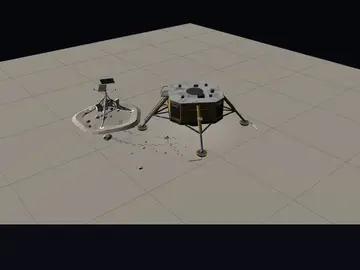
On the 3D Moon this hidden find sits in the Sea of Serenity, at the spot where Beresheet crashed in 2019 with its tiny cargo of dried water bears.
More on the Moon


Sources
- Read more on Wikipedia
- Beresheet — Wikipedia
- Beresheet Impact Site Spotted — NASA
- Tardigrades on the Moon: lunar library on Beresheet — EarthSky
- Tardigrades Designed for High Impact Collisions — CosmoQuest
- Tardigrade — Wikipedia
Updated: 2026-10-19