
Thonis-Heracleion (sunken city)
헤라클레이온 수몰 도시 (토니스)
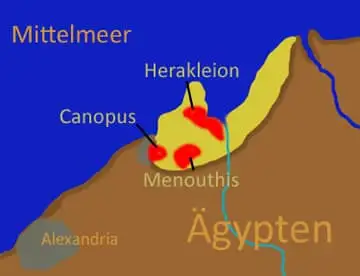
Before Alexandria was founded, Thonis-Heracleion was Egypt's greatest port, at a mouth of the Nile; earthquakes and ground that turned soft and watery slowly sank it into the sea. In 2000 Franck Goddio's team rediscovered it about 6.5 km off the coast of Aboukir Bay, some 10 m under water. Divers found a 5.4 m red-granite colossus of the Nile god Hapi, a great temple and more than 60 ancient ships.
See it on the 3D globe →At a glance
- Country
- Egypt
- Type
- Ancient site
- Kind
- Deep sea
Quick answers
Where is Thonis-Heracleion (sunken city)?
Thonis-Heracleion (sunken city) is in Egypt.
Heracleion, also called Thonis, was an ancient Egyptian port city at a mouth of the Nile, about 32 kilometres northeast of Alexandria. Over many centuries it slowly sank into the Mediterranean Sea. Today its ruins lie in Abu Qir Bay, on the seabed at roughly 5.8 metres deep, a few kilometres off the coast.
Before Alexandria was founded, Heracleion was Egypt's main port for foreign trade and for collecting taxes. Underwater archaeologists found the lost city in 2000, and divers have since mapped temples, ships and giant statues lying on the seabed. Its ruins show how an entire city can be lost to the sea.
A busy port of the pharaohs
The city grew up on small islands in the Nile Delta, with canals, harbours, ferries and bridges. It had a great temple of the god Amun-Gereb, and sanctuaries of Osiris that drew pilgrims who wanted to be healed. Between the sixth and fourth centuries BC it flourished. Merchant ships brought goods, which were taxed and sent up the Nile. Greek traders lived there too, and the Greeks called the city Heracleion.
How it disappeared
After Alexandria rose in the second century BC, Heracleion lost importance. Earthquakes, tsunamis and rising seas weakened the city. Around 101 BC the soft clay under the central island turned liquid in a process called liquefaction, and buildings collapsed into the water. By the end of the eighth century AD the last of it had sunk. The city stayed lost until divers led by Franck Goddio found it in 2000.
Fun facts
- This ancient Egyptian port slowly sank beneath the sea and was found again in 2000, with giant statues still lying on the seabed.
- A stele, or carved stone slab, shows the city had both an Egyptian name, Thonis, and a Greek name, Heracleion.
- Divers found a red-granite colossus about 5.4 metres tall, a statue of the Nile god Hapy.
- The sinking may have come from soil liquefaction, when firm clay turns to liquid.
On the globe
The toy globe puts Heracleion off the Egyptian coast in Abu Qir Bay, east of Alexandria. Look for the sunken city under the water.
Quiz time
Which is older: Thonis-Heracleion (sunken city) or Pyramids of Giza?
Show the answer
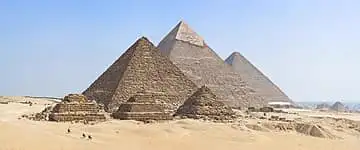
Pyramids of Giza. (2000 vs 2560 BC) Pyramids of Giza →
Nearby on the globe

Sources
Updated: 2026-10-14