
Citadel of Saladin & Muhammad Ali Mosque
카이로 성채와 무함마드 알리 모스크
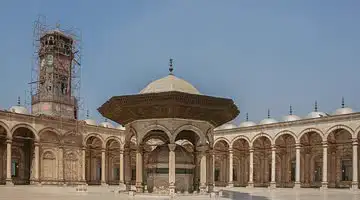
The Cairo Citadel is a medieval fortress on a hill above Cairo, Egypt. The Muslim leader Saladin began building it in 1176 to protect the city from Crusader attacks and to give his new government a safe home, and the main walls were completed around 1183-1184. Today its skyline is marked by the Mosque of Muhammad Ali with its two tall, thin minarets.
See it on the 3D globe →At a glance
- Country
- Egypt
- Location
- Cairo, Egypt
- Built
- 1176 (mosque 1848)
- Height
- 82 m
- Type
- Fort
Quick answers
Where is Citadel of Saladin & Muhammad Ali Mosque?
Citadel of Saladin & Muhammad Ali Mosque is in Cairo, Egypt.
How tall is Citadel of Saladin & Muhammad Ali Mosque?
Citadel of Saladin & Muhammad Ali Mosque is about 82 m tall.
Saladin's hilltop fortress, crowned by the Ottoman-style Mosque of Muhammad Ali with its twin pencil minarets.
For almost 700 years the citadel was the seat of Egypt's government, until Khedive Ismail moved to Abdeen Palace in 1874. It stands on a promontory under the Muqattam Hills, a spot that was hard to attack. It is part of the Historic Cairo UNESCO World Heritage Site and opened to the public in 1983.
Saladin and the sultans
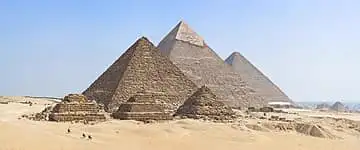
Saladin copied the walled citadels he knew from Syrian cities such as Damascus and Aleppo. He put his close adviser Baha al-Din Qaraqush in charge. Most of the stone was limestone cut from the nearby hills, but Qaraqush also took stone from a number of small pyramids at Giza and Abusir, and Christian prisoners of war supplied labour. Later Mamluk rulers expanded the fortress, especially al-Nasir Muhammad in the 14th century, who added palaces and a large mosque.
Two enclosures
The citadel has two main parts. The Northern Enclosure was for soldiers and today holds the National Military Museum, while the Southern Enclosure was the sultan's home and now holds the Mosque of Muhammad Ali. Below the walls was a big open field used to train horses and hold parades, whose outline still shows in the street layout. Only one original Saladin-era gate, Bab al-Mudarraj, survives.
Muhammad Ali's mosque
After the Ottomans took over Egypt in 1517 the site was neglected and used by military garrisons. Muhammad Ali Pasha, ruler of Egypt from 1805 to 1848, tore down many older buildings and built new palaces and the great mosque, started in 1828 and finished in 1857. Its large dome and Ottoman-style minarets make it one of the best-known sights of Cairo.
Fun facts
- The Mosque of Muhammad Ali on top of the citadel was completed in 1848.
- The mosque's minarets are tall and thin like pencils.
- The citadel stayed the government's seat for about seven centuries.
- Some of its stone came from small pyramids.
- Saladin planned a wall about 20 kilometres long around Cairo and Fustat.
On the globe
The model shows a hilltop fortress with the big domed mosque and two slender minarets. Look for the pencil-shaped towers.
Quiz time
Which is taller: Citadel of Saladin & Muhammad Ali Mosque or Al-Azhar Mosque?
Show the answer
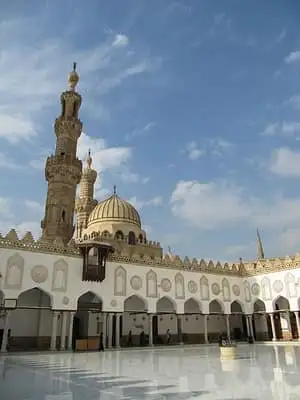
Citadel of Saladin & Muhammad Ali Mosque. (82 m vs 60 m) Al-Azhar Mosque →
Nearby on the globe


Sources
- Read more on Wikipedia
- Cairo Citadel — Wikipedia
- 카이로 성채 — 위키백과
- Cairo Citadel — Wikipedia (full article)
Updated: 2026-10-14