
Alhambra
알람브라 궁전
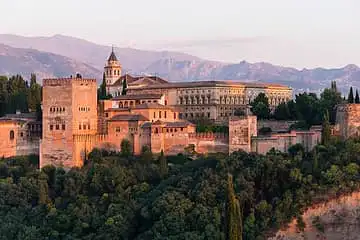
The Alhambra is a palace and fortress complex on a hill above Granada, in southern Spain. It is one of the most famous examples of Islamic architecture and the only well-preserved palace from the medieval Islamic world. It also holds a Renaissance palace added by a later Christian emperor. Today it is a UNESCO World Heritage Site and one of Spain's top attractions.
See it on the 3D globe →At a glance
- Country
- Spain
- Location
- Granada, Spain
- Built
- 13th–14th c.
- Type
- Palace
Quick answers
Where is Alhambra?
Alhambra is in Granada, Spain.
A Nasrid palace-fortress famed for its intricate Islamic decoration, courtyards and gardens.
It was begun in 1238 by Muhammad I, the first Nasrid emir, whose family ruled Granada, the last Muslim state in Spain. The name comes from Arabic and means "the red one", after the reddish colour of its walls, which were built of rammed earth. The colour comes from iron oxide in the local clay.
A city inside a fortress
In Nasrid times the Alhambra was a self-contained royal city separate from Granada below. It had a mosque, public baths, roads, houses, workshops and a clever water supply. At least six major palaces stood here, mostly along the northern edge with views over the Albaicín quarter.
The most important ones were built in the 14th century under the rulers Yusuf I and Muhammad V. The best preserved are the Mexuar, the Comares Palace, the Palace of the Lions and the Partal Palace. The Alcazaba fortress guards the western tip.
Courtyards, water and patterns
Nasrid palaces are built around courtyards, which were the basic unit that halls and rooms were arranged around. A pool or a fountain often sits in the middle. The decoration is mostly inside: tile mosaics on the lower walls, carved stucco higher up, with geometric patterns, plants and Arabic writing.
Ceilings and vaults use muqarnas, a three-dimensional carving that looks like stalactites. Just outside the walls, the Generalife was a country estate and summer palace with orchards and gardens.
After the Muslim rulers
In 1492 the Christian monarchs Ferdinand and Isabella took Granada, and the Alhambra became their royal court, where Christopher Columbus received support for his voyage. In 1526 Charles V began a Renaissance palace right beside the older ones.
Later the buildings fell into disrepair and were used by squatters, and Napoleon's troops damaged parts in 1812. Then travellers and writers, above all Washington Irving, made it famous again.
Fun facts
- Its name comes from the Arabic for 'the red one', after the colour of its walls.
- Washington Irving's book Tales of the Alhambra (1832) helped bring the palace world attention.
- Columbus got royal approval for his expedition at the Alhambra.
- The walls are red because the local clay holds iron oxide.
- Most of the names of the rooms used today were invented after the Middle Ages, often in the 19th century.
On the globe
The model shows the walls, towers and palace halls on a hilltop. Look for the red-brown fortress walls and the courtyards.
Nearby on the globe

Sources
Updated: 2026-10-14