
Badshahi Mosque
바드샤히 모스크
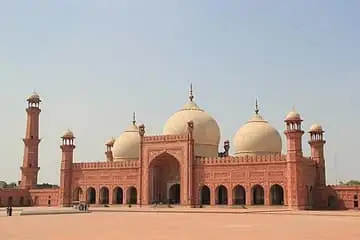
Imperial mosque built 1671–1673 by the Mughal emperor Aurangzeb, of carved red sandstone inlaid with white marble. Four octagonal minarets about 54 m tall stand at the corners of its vast courtyard, and the prayer hall carries three white-marble domes.
See it on the 3D globe →At a glance
- Country
- Pakistan
- Location
- Lahore, Pakistan
- Built
- 1673
- Height
- 53.75 m
- Type
- Religious building
Quick answers
Where is Badshahi Mosque?
Badshahi Mosque is in Lahore, Pakistan.
When was Badshahi Mosque built?
Badshahi Mosque was built in 1673.
The Badshahi Mosque is a grand imperial mosque in Lahore, Pakistan, built by the Mughal emperor Aurangzeb between 1671 and 1673. Its walls are red sandstone decorated with white marble inlay, three white marble domes crown the prayer hall, and tall minarets (slender towers) stand at the corners. The huge courtyard can hold up to about 100,000 worshippers.
It was the largest mosque built in the Mughal era, and it stayed the largest in the world for more than 300 years. It stands at the edge of the old Walled City, directly across from the Lahore Fort, and today it is one of the best-known landmarks of Lahore and of Pakistan. Its Urdu name means roughly the emperor's mosque.
Aurangzeb's mosque
Aurangzeb ordered the mosque in 1671, and the work was overseen by his foster brother Fidai Khan Koka, who was the governor of Lahore. It opened in 1673 or 1674, after only about two years of building. It was meant partly to mark the emperor's military campaigns in southern India.
The plan is similar to the Jama Masjid in Delhi, but on a much bigger scale. Instead of the colourful tile work common in Lahore, it uses red sandstone with white marble inlay. The corner minarets are around 54 to 60 metres tall, depending on how they are measured.
Changing fortunes
After the Sikh army took Lahore in 1799, the courtyard was used as a stable for army horses, and the small rooms around it housed soldiers. The British used the mosque as a garrison after 1849, and set up the Badshahi Mosque Authority in 1852 to repair it. They handed it back to the Muslim community in 1856.
Large repairs began in 1939 and were finished in 1960, at a cost of 4.8 million rupees.
Visiting today
The entrance faces the Alamgiri Gate of the Lahore Fort across a garden called Hazuri Bagh. Near the entrance lies the tomb of the poet Muhammad Iqbal, who is widely honoured in Pakistan.
In 1974, thirty-nine leaders of Muslim countries prayed here during a summit held in Lahore. Pakistan placed the mosque on its tentative list for UNESCO World Heritage in 1993. In 2008, worn courtyard tiles began to be replaced with red sandstone from the same area in Rajasthan that supplied the original stone.
Fun facts
- The courtyard can hold about 100,000 worshippers.
- It was the world's largest mosque for more than 300 years.
- In the 1800s the courtyard was used as a stable and the mosque as an army base.
- New courtyard stones put in from 2008 came from the same region of Rajasthan as the original Mughal stone.
On the globe
The model shows the red sandstone mosque with its marble domes and corner minarets around a huge courtyard.
Quiz time
Which is older: Badshahi Mosque or Faisal Mosque?
Show the answer
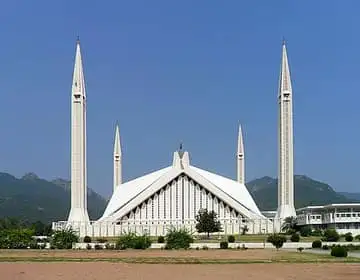
Badshahi Mosque. (1673 vs 1986) Faisal Mosque →
Nearby on the globe

Sources
Updated: 2026-10-14