
Jama Masjid, Delhi
자마 마스지드 (델리)
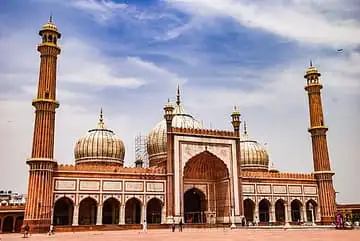
One of India's largest mosques, built by Shah Jahan in 1650–1656. Red sandstone cloisters and gates surround a vast raised courtyard; the prayer hall carries three white marble domes striped in black and two 41 m minarets.
See it on the 3D globe →At a glance
- Country
- India
- Location
- Old Delhi, Delhi, India
- Built
- 1656
- Height
- 41 m
- Type
- Religious building
Quick answers
Where is Jama Masjid, Delhi?
Jama Masjid, Delhi is in Old Delhi, Delhi, India.
When was Jama Masjid, Delhi built?
Jama Masjid, Delhi was built in 1656.
How tall is Jama Masjid, Delhi?
Jama Masjid, Delhi is about 41 m tall.
The Jama Masjid in Old Delhi, officially the Masjid-i-Jehan-Numa, is one of the largest mosques in India. The Mughal emperor Shah Jahan built it in about 1650 to 1656, at the highest point of his new capital Shahjahanabad, now Old Delhi. It was the imperial mosque of the Mughal emperors until the empire ended in 1857, and it is still used for worship today.
Its first name means 'the mosque that reflects the whole world', and Jama Masjid means 'congregational mosque' or Friday mosque. About 5,000 workers built it, and it cost ten lakh, or one million, rupees at the time. The mosque faces the Red Fort and stands near the busy market street of Chandni Chowk, and it is a Monument of National Importance.
Building and opening
The building was supervised mainly by Sadullah Khan, Shah Jahan's prime minister, and Fazil Khan, who managed the emperor's household. The workers came from many places: Indians, Arabs, Persians, Turks and Europeans. The mosque was opened on 23 July 1656 by Syed Abdul Ghafoor Shah Bukhari, an imam from Bukhara whom Shah Jahan had invited to be the royal imam. It was one of the last monuments built under Shah Jahan.
A place of power
On Friday noon prayers the khutba, a sermon, was recited in the emperor's name, which showed his rule to the city, so the mosque was a symbol of Mughal power. It was also a social centre where people from different classes met. In 1757 the khutba was read in the name of the Afghan conqueror Ahmad Shah Durrani. The British took over the city in 1803 and at first repaired the mosque.
After 1857
After the Revolt of 1857 the British razed many mosques and banned Muslims from gathering in the rest. The Jama Masjid was confiscated and barred from religious use. It was repeatedly considered for destruction, but was used as barracks for Sikh and European soldiers instead. It was returned to the Muslim community in 1862 under conditions. The tomb of the independence activist Abul Kalam Azad lies next to it.
Fun facts
- Its courtyard can hold about 25,000 worshippers.
- About 5,000 workers built the mosque.
- Its first name means 'mosque that reflects the whole world'.
- It was returned to Muslims in 1862, five years after the Revolt of 1857.
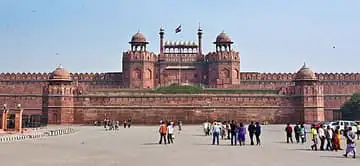
- Across the street from it stands the Red Fort.
On the globe
The model shows the red sandstone mosque with its three striped marble domes and two minarets.
Quiz time
Which is taller: Jama Masjid, Delhi or Red Fort?
Show the answer
Jama Masjid, Delhi. (41 m vs 33 m) Red Fort →
Nearby on the globe

Sources
Updated: 2026-10-14