
Golden Temple (Harmandir Sahib)
황금 사원
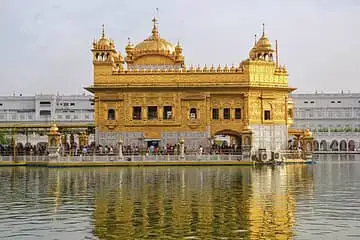
The Golden Temple, known to Sikhs as Harmandir Sahib ("the house of God") or Darbar Sahib, is the holiest place of Sikhism. It stands in the city of Amritsar in Punjab, in northern India, in the middle of a large sacred pool called the Amrit Sarovar. Its central shrine is covered in gold leaf, which shines on the water and gives the temple its English name.
See it on the 3D globe →At a glance
- Country
- India
- Location
- Amritsar, India
- Built
- 1604
- Type
- Religious building
Quick answers
Where is Golden Temple (Harmandir Sahib)?
Golden Temple (Harmandir Sahib) is in Amritsar, India.
When was Golden Temple (Harmandir Sahib) built?
Golden Temple (Harmandir Sahib) was built in 1604.
The holiest shrine of Sikhism, a gilded temple in the middle of a sacred pool.
A Sikh temple is called a gurdwara, and this one welcomes everyone, whatever their religion, background or wealth. More than 150,000 people visit every day, making it one of the most visited religious sites in the world. Its community kitchen, the langar, serves free vegetarian meals to all, more than 100,000 a day, cooked and served by volunteers.
History
The fourth Sikh Guru, Guru Ram Das, completed the sacred pool in 1577, and a town grew around it that became Amritsar. The fifth Guru, Guru Arjan, built the temple in the middle of the pool and in 1604 placed the Sikh holy scripture inside it. Over the following centuries the temple was attacked and destroyed several times, and each time Sikhs rebuilt it. In the early 1800s Maharaja Ranjit Singh, ruler of the Sikh Empire, rebuilt it in marble and copper and covered the inner shrine with gold leaf in 1830.
A temple open to all
The design carries a message. Instead of placing the temple high above the city, Guru Arjan built it on a lower level, as a sign of humility. It has a door on each of its four sides, east, west, north and south, to show that people from every direction and every group are welcome. Visitors cross a causeway about 60 metres long to reach the shrine, and walk around the pool on a marble path. Inside, the scripture is read aloud continuously.
The free kitchen
The langar is a community kitchen that never charges anyone. Anyone can come and eat, no matter their faith, gender or income. Everyone sits together on the floor in long rows, so rich and poor eat side by side as equals. Volunteers cook, serve and wash up as an act of service, which Sikhs call seva. The kitchen sits beside the courtyard on the east side of the complex, and the food served there is always vegetarian.
Fun facts
- The temple's kitchen serves more than 100,000 free vegetarian meals every day.
- The temple has four doors, one on each side, to show that everyone is welcome.
- The temple was built lower than the city around it, as a reminder to be humble.
- The gold covering was added in 1830 by Maharaja Ranjit Singh.
On the globe
The model shows the gilded temple standing in the middle of its sacred pool in Amritsar. Zoom in to see the golden shrine reflected in the water around it.
Quiz time
Which is older: Golden Temple (Harmandir Sahib) or Minar-e-Pakistan?
Show the answer
Golden Temple (Harmandir Sahib). (1604 vs 1968) Minar-e-Pakistan →
Nearby on the globe

Sources
- Read more on Wikipedia
- Golden Temple — Wikipedia
- 황금 사원 — 위키백과
- Sri Harmandir Sahib — Shiromani Gurdwara Parbandhak Committee (SGPC)
Updated: 2026-10-13