
Buda Castle
부다 왕궁
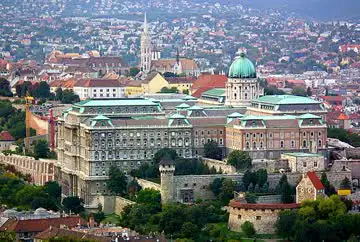
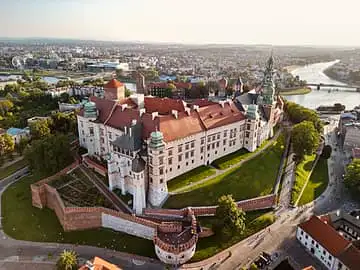
Buda Castle, also called the Royal Palace, is the historic castle and palace complex of the Hungarian kings in Budapest. It stands on the southern tip of Castle Hill, above the Danube. The first royal residence was built there between 1247 and 1265. The huge Baroque palace you see today was built from 1749 to 1769, badly damaged in the Siege of Budapest in World War II, and rebuilt in a simpler Baroque style afterward.
See it on the 3D globe →At a glance
- Country
- Hungary
- Location
- Budapest, Hungary
- Built
- 1912
- Type
- Palace
Quick answers
Where is Buda Castle?
Buda Castle is in Budapest, Hungary.
When was Buda Castle built?
Buda Castle was built in 1912.
The Hungarian royal palace on Castle Hill above the Danube, crowned by a green copper dome.
Today the palace holds the Hungarian National Gallery, the Budapest History Museum and the National Széchényi Library. The castle's defensive walls surround the whole Castle Quarter to the north, a neighbourhood of medieval, Baroque and neoclassical houses and churches. A funicular railway connects Castle Hill to the Széchenyi Chain Bridge, and the area became part of a UNESCO World Heritage Site in 1987.
Medieval grandeur
King Béla IV began the first royal residence on the hill in 1247. King Sigismund later turned it into probably the largest Gothic palace of the late Middle Ages. His Fresh Palace had a Roman Hall 70 metres long. Under King Matthias Corvinus, who married Beatrice of Naples in 1476, Italian artists came to Buda, and the city became the first centre of the Renaissance north of the Alps. The palace had two rooms with golden ceilings, including the library Bibliotheca Corviniana.
Destruction and a new palace
In the war that drove the Ottoman Turks from Buda, many buildings burned and collapsed. Stephen's Tower, used by the Ottomans to store gunpowder, exploded when a cannon shot hit it, said to be fired by a friar called Fiery Gabriel. By 1715 the ruins were pulled down and a small Baroque palace was built. Then Queen Maria Theresa had the great U-shaped Baroque palace built; the first stone was laid on 13 May 1749, her birthday.
New life as a university and museum
The Queen did not live in the palace and gave a wing to nuns, and in 1777 she moved the university of Nagyszombat there. A four-storey observatory tower was added. Later in 1778 a chapel was built for the mummified right hand of Saint Stephen, the first king of Hungary. After the damage of World War II the palace was rebuilt, and it is now a place for museums and libraries.
Fun facts
- Today it houses the Hungarian National Gallery and the Budapest History Museum.
- The Roman Hall in King Sigismund's palace was 70 metres long.
- A cannon shot is said to have blown up the gunpowder in Stephen's Tower, killing as many as 1,500 soldiers, according to contemporary sources.
- The Baroque palace's first stone was laid on Queen Maria Theresa's birthday, 13 May 1749.
- The Hungarian National Gallery is housed inside the palace today.
On the globe
The model shows the long royal palace on its hill with a green copper dome.
Quiz time
Which is older: Buda Castle or St. Stephen's Cathedral?
Show the answer
St. Stephen's Cathedral. (1912 vs 1511) St. Stephen's Cathedral →
Nearby on the globe


Sources
Updated: 2026-10-14