
Suez Canal
수에즈 운하
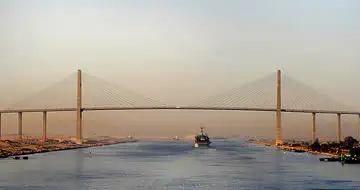
A 193 km sea-level canal linking the Mediterranean and the Red Sea; opened in 1869, it lets ships sail between Europe and Asia without rounding Africa.
See it on the 3D globe →At a glance
- Country
- Egypt
- Location
- Ismailia, Egypt
- Built
- 1869
- Type
- Infrastructure
Quick answers
Where is Suez Canal?
Suez Canal is in Ismailia, Egypt.
When was Suez Canal built?
Suez Canal was built in 1869.
The Suez Canal is a human-made waterway in Egypt that joins the Mediterranean Sea to the Red Sea. It runs about 193 kilometres from Port Said in the north to the city of Suez in the south, cutting through a narrow strip of land called the Isthmus of Suez. The canal also marks the boundary between Africa and Asia.
Before the canal opened in 1869, ships sailing between Europe and Asia had to go all the way around the southern tip of Africa. Using the canal cuts the trip from the Arabian Sea to London by about 8,900 kilometres. That makes it one of the most important shipping routes on Earth: in 2021 more than 20,600 ships passed through, an average of about 56 a day.
How it was built
People dreamed of linking these seas for thousands of years. Ancient Egyptian and Persian rulers dug canals from the Nile River to the Red Sea, but those silted up. The modern canal was the project of a French diplomat, Ferdinand de Lesseps, who won an official permission, called a concession, in 1854 to set up a company to dig it. Digging began on 25 April 1859 at the spot that became Port Said. The work took ten years. For the first years many Egyptian workers were forced to dig, and tens of thousands are thought to have died, many from diseases such as cholera. The two seas met on 18 August 1869, and the canal opened on 17 November 1869.
How ships use it
The Suez Canal is a sea-level canal, which means it has no locks: seawater flows freely along it, and ships do not need to be lifted or lowered. Much of it is a single lane, so ships travel in groups called convoys, usually two heading south and one heading north each day. They pass each other at wider places such as the Great Bitter Lake and the Ballah Bypass. A trip takes about 11 to 16 hours, and ships move slowly, around 15 km/h, so their waves do not wash away the banks. The canal has been widened and deepened many times since 1869.
Closures and blockages
In 1956 Egypt's president Gamal Abdel Nasser nationalised the canal, meaning Egypt took over the company that ran it, which led to a short war called the Suez Crisis. After the Six-Day War began in 1967, the canal was closed for eight years and only reopened in 1975. In March 2021 the giant container ship Ever Given ran aground in strong winds, turned sideways and blocked the whole canal for six days, until it was finally pulled free and about 450 waiting ships could move again.
Fun facts
- In 2021 the giant container ship Ever Given blocked the canal for six days.
- When the canal closed in 1967, fifteen cargo ships were trapped inside for eight years; they became known as the Yellow Fleet.
- Napoleon gave up on building a canal here because his engineers wrongly believed the Red Sea was about 8.5 metres higher than the Mediterranean.
- When it opened in 1869 the canal was about 164 kilometres long and 8 metres deep; today it is about 193 kilometres long and around 24 metres deep.
- More than a thousand kinds of sea life from the Red Sea, from plankton to fish, have travelled through the canal and been found in the Mediterranean; scientists call this Lessepsian migration, after de Lesseps.
On the globe
The model shows the long sea-level canal crossing Egypt between the Mediterranean and the Red Sea. Zoom in to follow the waterway that lets ships sail between Europe and Asia without going around Africa.
Quiz time
Which is older: Suez Canal or Al-Azhar Mosque?
Show the answer
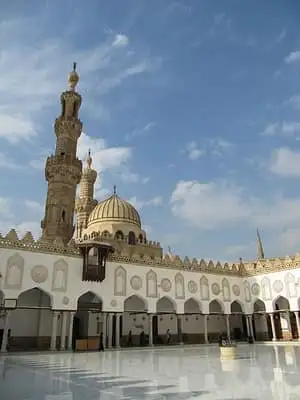
Al-Azhar Mosque. (1869 vs 972) Al-Azhar Mosque →
Nearby on the globe

Sources
Updated: 2026-10-13