
Dokdo
독도
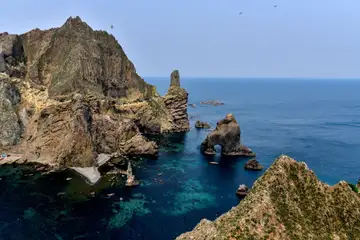
Dokdo is a group of small volcanic islets in the East Sea, also called the Sea of Japan, between the Korean Peninsula and the Japanese islands. It has two main islets, Dongdo (East Island) and Seodo (West Island), and about 89 smaller rocks. South Korea administers it as part of Ulleung County; Japan also claims it and calls it Takeshima. In English it is often called the Liancourt Rocks, after a French whaling ship that nearly hit the rocks in 1849.
See it on the 3D globe →At a glance
- Country
- South Korea
- Location
- Ulleung County, South Korea
- Height
- 169 m
Quick answers
Where is Dokdo?
Dokdo is in Ulleung County, South Korea.
How tall is Dokdo?
Dokdo is about 169 m tall.
Two volcanic islets in the East Sea, Dongdo and Seodo, ringed by dozens of rocks.
Together the islets cover only about 187,554 square metres, less than a quarter of a square kilometre. Seodo is the taller one, reaching 168.5 metres, while Dongdo reaches about 98.6 metres and has more usable flat land. The islets are the tops of a volcano that rises from a sea floor about 2,000 metres deep. They are a protected seabird habitat and an important symbol in Korea.
How the islets formed
Dokdo is made of volcanic rock formed roughly 4.6 to 2.5 million years ago, which is young compared with most land. Over that time waves and weather have worn it down, and geologists describe it as eroding fairly quickly. The two main islets stand only 151 metres apart. Seodo has a single peak and many sea caves along its coast, while Dongdo has cliffs of about 10 to 20 metres, two large caves open to the sea, and a hollow where the ceiling collapsed. Korean names for rocks include Independence Gate Rock, which is a sea arch.
Weather and wildlife
The islets are rocky with only a thin layer of soil and moss, and the climate is warm and humid because of warm sea currents. Fog is common. If swells are above 3 to 5 metres, boats cannot land, so ferries can dock only about once in forty days on average. Researchers have found about 49 plant species, 107 bird species and 93 insect species, plus 160 kinds of algae and 368 kinds of sea invertebrates. In 1982 South Korea made it Natural Monument number 336 as a breeding ground for storm petrels, shearwaters and black-tailed gulls.
People and visiting
Few people live here. As of March 2026, three office staff, two lighthouse managers and twenty police personnel lived on the islets. In 1965 Choi Jong-duk moved from Ulleungdo to fish for octopus, and in 1981 he made Dokdo his official address. The islets have a lighthouse, a helicopter pad and desalination plants for drinking water. Visitors travel by ferry from Ulleungdo, and in 2025 about 192,000 tourists visited, roughly 500 a day.
Fun facts
- It consists of two main islets, Dongdo and Seodo, and 89 smaller rocks.
- The English name Liancourt Rocks comes from a French whaling ship that almost wrecked there in 1849.
- The two main islets are only 151 metres apart.
- From Ulleungdo, 87.4 kilometres away, the islets can sometimes be seen with the naked eye in clear weather.
- Cetaceans such as minke whales, orcas and dolphins pass through the waters nearby.
On the globe
The model shows the two steep volcanic islets, Dongdo and Seodo, ringed by small rocks; look for the pair of rocky peaks.
Quiz time
Which is taller: Dokdo or Seokguram Grotto?
Show the answer
Dokdo. (169 m vs 3.5 m) Seokguram Grotto →
Nearby on the globe
Sources
Updated: 2026-10-14