
Fasil Ghebbi
파실 게비
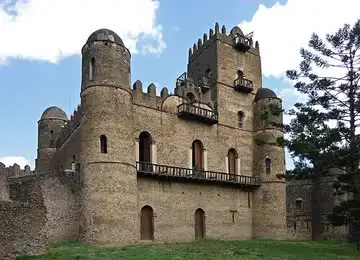
Fasil Ghebbi is a royal fortress-city compound in Gondar, in the Amhara Region of Ethiopia. Emperor Fasilides founded it in the 17th century, and it was the home of Ethiopian emperors for generations. The word ghebbi in Amharic means a compound or enclosure. UNESCO made it a World Heritage Site in 1979 because of its historical importance and its architecture, which mixes Ethiopian, Portuguese, Hindu and Arab influences.
See it on the 3D globe →At a glance
- Country
- Ethiopia
- Location
- Gondar, Ethiopia
- Built
- 1636
- Height
- 32 m
- Type
- Castle
Quick answers
Where is Fasil Ghebbi?
Fasil Ghebbi is in Gondar, Ethiopia.
How tall is Fasil Ghebbi?
Fasil Ghebbi is about 32 m tall.
Gondar's royal enclosure begun by Emperor Fasilides, a cluster of stone castles with domed round towers.
The enclosure covers about 70,000 square metres and is ringed by a 900-metre curtain wall with twelve gates. Inside are Fasilides' castle, the palaces of Iyasu I, Dawit III's Hall, the castle of Empress Mentewab, a chancellery and library, a banqueting hall, stables and three churches. The buildings were made of brown basalt with wine-coloured volcanic tuff for decoration.
A capital that stayed put
Earlier Ethiopian emperors travelled around their lands, living in tents and eating what local farmers produced. Fasilides broke with this tradition and founded Gondar as a permanent capital. Later emperors such as Yohannes I, Iyasu I and Dawit III built their own buildings in the same compound, so it grew a lot. The palaces looked like fortresses and were decorated with paintings and illuminated manuscripts.
Who built it?
A Yemeni ambassador who visited in 1648, when the palace was still new, wrote that the architect of Fasilides' castle was an Indian called Abdal Kerim. He called the palace a house of stone and lime and one of the marvels of its time. The Royal Chronicles name an Ethiopian architect, Walda Giyorgis, for the buildings of Yohannes I and Iyasu I. Much of the heavy work was done by the Beta Israel, local Ethiopian Jews, who were skilled masons, metalworkers and carpenters.
Gates, hall and survival
The twelve gates have names such as the Gate of the Judges, the Gate of the Musicians and the Gate of the Spinners. Dawit's Hall, in the north, is often called the House of Song, but the name may come from a misreading of the Amharic for House of the Divan, or throne room; as of 2002 it had no roof. Many buildings did not survive the events of the centuries, but the Italians in the late 1930s and later Ethiopian governments renovated others. The site has also been through preservation work in 2025.
Fun facts
- The wall around the compound is 900 metres long and has twelve gates.
- The enclosure covers about 70,000 square metres.
- The palaces mix Ethiopian, Portuguese, Hindu and Arab styles.
- Dawit's Hall is called the House of Song, though the name may come from a misreading.
On the globe
The model shows stone castles with domed round towers. Look at the tall towers and the walls that enclose them.
Quiz time
Which is taller: Fasil Ghebbi or Church of St. George, Lalibela?
Show the answer
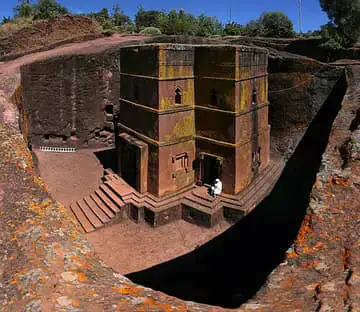
Fasil Ghebbi. (32 m vs 12 m) Church of St. George, Lalibela →
Nearby on the globe





Sources
Updated: 2026-10-14