
Danakil Depression (Dallol)
다나킬 함몰지 (달롤)
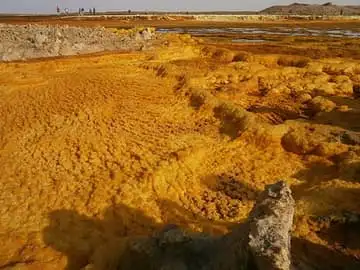
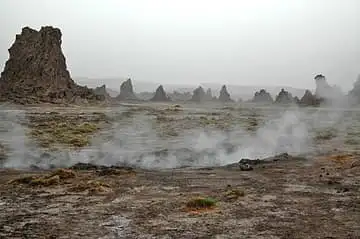
The Danakil Depression in the Afar region of Ethiopia lies more than 100 m below sea level and is one of the hottest places on Earth, with yearly average temperatures well above 30 °C. At its heart, Dallol's scalding acid hot springs paint the ground with yellow sulphur, lime-green pools and white salt, a landscape that looks like another planet. Afar miners still cut slabs of salt here and carry them away by camel caravan.
See it on the 3D globe →At a glance
- Country
- Ethiopia
- Kind
- Mysteries
Quick answers
Where is Danakil Depression (Dallol)?
Danakil Depression (Dallol) is in Ethiopia.
Dallol is a hot-spring and salt landscape in the Danakil Depression of northern Ethiopia, around a small volcano. It is known for its unearthly yellow, green, orange and brown colours and for pools of extremely acidic water.
The area is one of the driest and hottest places on the planet and also one of the lowest, with the salt plain lying about 125 metres below sea level. People of the Afar region named it Dallol, a word meaning dissolution or disintegration. Visitors can see bright mineral patterns and salt pillars here, but the fumes and boiling, acidic pools make the place dangerous without expert guides.
Why is it so colourful?
Hot springs here push out salty, very acidic water, with an acidity (pH) below 1 in places, which is stronger than many acids you may know. The springs are also almost ten times saltier than seawater and hotter than 108 degrees Celsius.
The bright yellow, ochre and brown tones come from iron and other impurities, while older springs that have stopped flowing turn dark brown as they rust. Small, short-lived geysers build cones of salt.
How did Dallol form?
Dallol formed when basalt magma pushed into thick salt deposits laid down long ago, heating groundwater. The mountain is only about 3 by 1.5 kilometres and rises roughly 60 metres above the salt plain.
A steam-driven explosion in 1926 made a crater, and nearby craters are the lowest known volcanic vents on land, at least 45 metres below sea level. The latest signs of activity were in 2011.
Fun facts
- Dallol's hot springs paint the ground bright yellow and green, and in the 1960s it averaged about 35 °C a year, the hottest of any place people have lived.
- Dallol means "dissolution" in the language of the Afar people.
- Its springs can be hotter than 108 degrees Celsius.
- Its salt plain lies about 125 metres below sea level.
On the globe
Find it on the globe in the Danakil Depression of northern Ethiopia and zoom in to open its card.
Nearby on the globe

Sources
Updated: 2026-10-14