
Church of St. George, Lalibela
랄리벨라 성 게오르기우스 교회
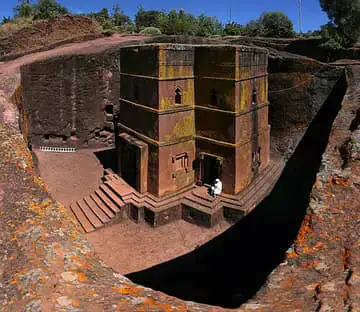
The Church of St George, called Bete Giyorgis in Ethiopia's Amharic language, is a church carved out of solid rock in Lalibela, a town in the highlands of northern Ethiopia. Instead of being built up from the ground, it was cut downward into the rock, so its flat roof sits at the same level as the ground around it. Seen from above, the roof is shaped like a cross.
See it on the 3D globe →At a glance
- Country
- Ethiopia
- Location
- Lalibela, Ethiopia
- Built
- 1200
- Height
- 12 m
- Type
- Religious building
Quick answers
Where is Church of St. George, Lalibela?
Church of St. George, Lalibela is in Lalibela, Ethiopia.
When was Church of St. George, Lalibela built?
Church of St. George, Lalibela was built in 1200.
How tall is Church of St. George, Lalibela?
Church of St. George, Lalibela is about 12 m tall.
A cross-shaped church carved downward from a single block of rock, the finest of Lalibela's rock-hewn churches.
It is the most famous of Lalibela's eleven rock-cut churches. Tradition says they were made for King Gebre Mesqel Lalibela, who ruled around the year 1200, though experts think the work may have taken place in several stages. The king wanted to create a new Jerusalem in Ethiopia. The churches are still used every day for worship by the Ethiopian Orthodox Church, and they have been a UNESCO World Heritage Site since 1978.
How it was carved
Workers first dug deep trenches around a block of soft, reddish volcanic rock, leaving the block standing free in the middle. Then they shaped the outside and hollowed out the inside, always working from the top down, using simple tools such as hammers and chisels. The church stands on a stepped platform in a square courtyard about 22 metres on each side and about 11 metres deep. Greek crosses, crosses with four equal arms, are carved into its roof. It has three doors and twelve windows, and each window is topped with a carved cross and flower pattern.
The story behind it
According to Ethiopian tradition, King Lalibela built the church after a vision in which he was told to make it; some stories say the message came from Saint George, others from God. Bete Giyorgis was one of the last of the eleven churches to be made, and today it is the best preserved. It stands alone, apart from the two main groups of churches. The way in was well hidden: visitors walk down a narrow passage cut into the rock that spirals downward and turns into a tunnel near the church.
Visiting today
Lalibela lies about 2,480 metres above sea level and is one of the most important pilgrimage places for Ethiopian Orthodox Christians. Priests hold services in the churches every day, and many pilgrims come for festivals such as Timkat, which celebrates the baptism of Jesus, and Genna, Ethiopian Christmas. Inside Bete Giyorgis is a simple shrine to Saint George. Behind a curtain that only priests may look behind is a copy of the Ark of the Covenant, a holy chest described in the Bible.
Fun facts
- Lalibela has 11 churches carved out of solid rock.
- Bete Giyorgis is sometimes called the "Eighth Wonder of the World".
- The town of Lalibela was originally called Roha.
- Besides its twelve real windows, the church has nine fake windows carved on the outside that do not open inside.
- All eleven churches of Lalibela were carved with basic tools such as hammers and chisels.
- From the ground nearby, you cannot see that the church is cross-shaped; it only becomes clear from above.
On the globe
The model shows the cross-shaped church sunk into its deep rock pit in Lalibela. Look down at the flat roof, level with the ground, to find the cross carved on top.
Quiz time
Which is taller: Church of St. George, Lalibela or Fasil Ghebbi?
Show the answer
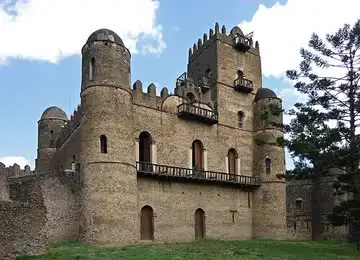
Fasil Ghebbi. (12 m vs 32 m) Fasil Ghebbi →
Nearby on the globe



Sources
- Read more on Wikipedia
- Church of Saint George, Lalibela — Wikipedia
- Rock-Hewn Churches, Lalibela — Wikipedia
- 랄리벨라 — 위키백과
- The Rock-Hewn Churches of Lalibela — Biblical Archaeology Society Library
Updated: 2026-10-13