
Fort McHenry
포트 맥헨리
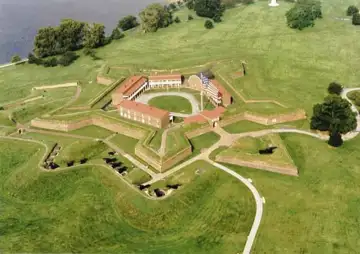
Fort McHenry is a historic coastal fort with five pointed corners on Locust Point in Baltimore, Maryland. It is best known for the War of 1812, when it held off a British Royal Navy attack on Baltimore Harbor on September 13-14, 1814. The sight of the American flag still flying over the fort the next morning inspired Francis Scott Key to write a poem that later became The Star-Spangled Banner, the national anthem of the United States.
See it on the 3D globe →At a glance
- Country
- United States
- Location
- Baltimore, USA
- Built
- 1800
- Type
- Fort
Quick answers
Where is Fort McHenry?
Fort McHenry is in Baltimore, USA, United States.
When was Fort McHenry built?
Fort McHenry was built in 1800.
The star-shaped fort whose flag, still flying after the 1814 bombardment, inspired "The Star-Spangled Banner".
The fort was built between 1798 and 1800, was used by U.S. armed forces through World War I, and was used by the Coast Guard in World War II. It became a national park in 1925 and a U.S. National Monument in 1939. It is named after James McHenry, a Scots-Irish immigrant who was a surgeon-soldier, a signer of the U.S. Constitution, and Secretary of War from 1796 to 1800.
A star-shaped fort
The French designer Jean Foncin planned the fort in 1798 to protect the growing Port of Baltimore. It stands on the site of the older Fort Whetstone, which guarded the city from 1776 to 1797. The new fort is a bastioned pentagon, a five-sided shape with a pointed bastion at each corner, surrounded by a dry moat. If attackers came by land, each point could fire cannons and rifles across the others, creating a crossfire.
The Battle of Baltimore
From 6 a.m. on September 13, 1814, British warships under Vice Admiral Alexander Cochrane bombarded the fort for 25 hours. The British guns could shoot about 2 miles and their rockets about 1.75 miles, but both were inaccurate, and a chain of 22 sunken ships blocked the harbor. Under Major George Armistead, the defenders lost four killed and 24 wounded, and one bomb that crashed through the powder magazine failed to explode. Out of ammunition, the British gave up on the morning of September 14.
The flag and the anthem
During the attack a smaller storm flag, 17 by 25 feet, flew over the fort. At dawn on September 14 it was replaced by a huge garrison flag 30 by 42 feet, which had been sewn by Mary Pickersgill. The Washington lawyer Francis Scott Key was watching from a nearby truce ship, where he had gone to negotiate the release of a prisoner, Dr. William Beanes. Seeing the flag still flying showed him the fort had held, and he wrote the poem Defence of Fort M'Henry.
Fun facts
- The 1814 flag was 30 by 42 feet, bigger than many rooms.
- The fort was named for James McHenry, a secretary of war.
- Its pentagon shape has pointed bastions, which is why it is called a star fort.
- The British bombarded the fort for 25 hours.
On the globe
The model shows the star-shaped fort with the flag flying in the middle. Look for the pointed corners.
Quiz time
Which is older: Fort McHenry or Teotihuacan?
Show the answer
Teotihuacan. (1800 vs 200) Teotihuacan →
Nearby on the globe

Sources
Updated: 2026-10-14