
Fort Santiago, Intramuros
인트라무로스 산티아고 요새
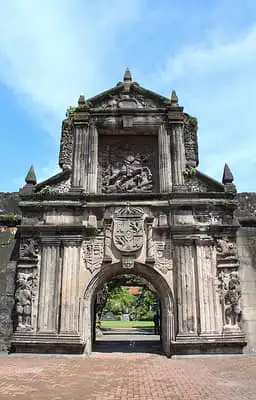
Fort Santiago is a Spanish-era citadel at the mouth of the Pasig River in Intramuros, the walled old city of Manila, Philippines. The Spanish navigator and governor Miguel Lopez de Legazpi started it for the newly founded city of Manila, and it is now one of the most important historical sites in the capital. It is named after Saint James, or Santiago, the patron saint of Spain.
See it on the 3D globe →At a glance
- Country
- Philippines
- Location
- Manila, Philippines
- Built
- 1593
- Type
- Fort
Quick answers
Where is Fort Santiago, Intramuros?
Fort Santiago, Intramuros is in Manila, Philippines.
A Spanish-era citadel guarding walled Intramuros, where national hero José Rizal was imprisoned.
For 333 years it was the main defence fortress of the Spanish government and a key fort for trade with the Americas and Europe. The Manila Galleon trade to Acapulco in Mexico began from here. National hero Jose Rizal was held in its prison before his execution in 1896, and today the fort is a museum and park.
Built and rebuilt
The spot was once a wooden fort of Rajah Matanda, a ruler of pre-Hispanic Manila. The Spaniards built a first fort of palm logs and earth after founding the city on 24 June 1571. Most of it was destroyed when pirates led by Limahong attacked. The stone fort was built from 1590 to 1593 under Governor-General Gomez Perez Dasmarinas, using volcanic tuff from Guadalupe. In 1714 the ornate gate was added, and the 1880 earthquakes damaged the front building.
Shape and defences
The fort is nearly triangular, with a perimeter of about 620 metres. Its walls are 6.7 metres high and 2.4 metres thick, and a moat connected to the river separates it from the city. Two bastions, San Fernando and San Miguel, guard the front. The gate is about 12 metres high, and inside were barracks, storehouses, a chapel and a powder magazine. A small hidden gate, the Postern of Our Lady of Solitude, led to the river and the sea.
Rizal's last walk
Many people died in the fort's prisons during Spanish rule and World War II. The Rizal Shrine museum shows objects that belonged to Jose Rizal. Bronze footprints set into the ground trace his final walk from his cell to the place of his execution. Fort Santiago stands near Manila Cathedral and the old Governor's Palace.
Fun facts
- National hero José Rizal was held here before his execution in 1896.
- The Manila Galleon trade to Acapulco, Mexico began from this fort.
- The first fort was made of palm logs and earth.
- Its walls are 6.7 metres high and 2.4 metres thick.
- Bronze footprints on the ground show Rizal's last walk.
On the globe
The model shows the old stone fort in Intramuros with its gate and walls. Look for the front gateway.
Nearby on the globe

Sources
Updated: 2026-10-14