
Mayon Volcano
마욘 화산
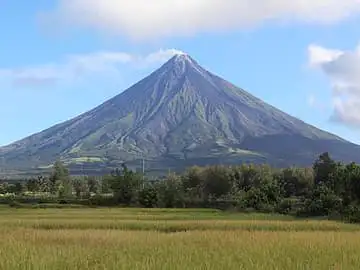
Mayon is an active volcano in Albay province in the Bicol region, on the Philippine island of Luzon. It rises 2,463 metres above Albay Gulf and is famous around the world for its almost perfect cone shape. It is the most active volcano in the Philippines, so scientists at PHIVOLCS watch it constantly from an observatory about 12 kilometres away.
See it on the 3D globe →At a glance
- Country
- Philippines
- Location
- Albay, Philippines
- Height
- 2,463 m
- Type
- Volcano
Quick answers
Where is Mayon Volcano?
Mayon Volcano is in Albay, Philippines.
An active volcano celebrated for its almost perfectly symmetrical cone.
Mayon is a stratovolcano, built up in layers of lava and ash, and it is sacred in Philippine mythology. In 1938 it and the land around it became the country's first national park, and since 2000 it has been the Mayon Volcano Natural Park. It is also the centrepiece of the Albay Biosphere Reserve, a UNESCO area declared in 2016, and it is being considered for World Heritage status.
Why is it so perfect?
Mayon has a smooth, concave profile, steep near the top and gentle at the bottom. Scientists explain that the shape comes from a balance between eruptions piling up material and erosion wearing it away. The steepest upper slopes are about 75 per cent, while the foot slope averages only 3 per cent. At least 85 lava flows have been identified on the cone, which sits in the Pacific Ring of Fire.
Living beside a volcano
Mayon has erupted about 50 times in the last four centuries. The first record is from 1616, and the most destructive eruption was in 1814, when lava buried the town of Cagsawa and more than 1,200 people died. Only a church tower is left there today. Because many people live and farm near its slopes, PHIVOLCS keeps hazard zones and tells communities when to leave.
Fun facts
- It is the most active volcano in the Philippines.
- Mayon's name is linked to a Bikol word meaning "beautiful".
- It became the Philippines' first national park in 1938.
- The 1814 eruption buried Cagsawa and left only a church tower standing.
- Its crater is about 250 metres across.
On the globe
The model shows Mayon's near-perfect cone, as on the card.
Nearby on the globe
.jpg)
Sources
Updated: 2026-10-14