
Golestan Palace
골레스탄 궁전
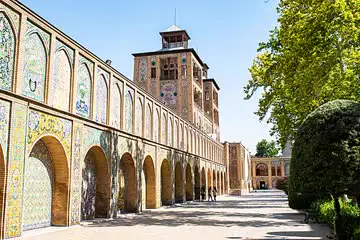
The Golestan Palace is the former royal palace complex of the Qajar dynasty in Tehran, Iran, and one of the oldest historic monuments in the capital. It is a UNESCO World Heritage Site and today it is used mainly as a group of museums. The palaces, halls and gardens are surrounded by a wall and once stood inside Tehran's old citadel.
See it on the 3D globe →At a glance
- Country
- Iran
- Location
- Tehran, Iran
- Built
- 16th–19th century
- Type
- Palace
Quick answers
Where is Golestan Palace?
Golestan Palace is in Tehran, Iran.
The Qajar royal palace, known for its dazzling tilework, mirror halls and the twin-towered Shams-ol-Emareh.
Most of the royal buildings date from the 19th century, and they show off Iranian crafts together with European crafts and gifts from the 18th to the 20th century. The palace was rebuilt into its present form in 1865. The name Golestan is often explained as meaning rose garden. Much of the decoration is dazzling, with mirror-work, tilework and carved marble.
From fort to royal home
Tehran's royal citadel dates back to the Safavid king Tahmasp I in the 1500s. The palace was renovated later by Karim Khan of the Zand dynasty, who built the Marble Throne terrace in 1747 to 1751. Agha Mohammad Khan of the Qajar dynasty chose Tehran as his capital, and from 1794 to 1925 the Golestan palace was the Qajar kings' official home.
Mirrors, ivory and a windcatcher
The Brilliant Hall is covered in Iranian mirror-work called Ayeneh-kari. The Ivory Hall was a dining room decorated with gifts that European monarchs gave to Naser ed-Din Shah, and the Edifice of the Sun, built from 1865, held a clock that Queen Victoria gave him. The Windcatcher Mansion, from the time of Fath-Ali Shah, has a tower that catches breezes to cool the rooms. In the Salam Hall the coronations of Reza Shah in 1926 and Mohammad Reza Shah in 1967 were held.
Lost buildings and recent damage
Between 1925 and 1945 Reza Shah ordered much of the complex to be torn down, believing the old Qajar palaces should not stand in the way of a modern city. Modern commercial buildings replaced them.
Fun facts
- It is one of the oldest historic monuments in Tehran.
- Almost all of the complex was built during the 131-year rule of the Qajar dynasty.
- The Brilliant Hall is covered in Iranian mirror-work.
- A clock given by Queen Victoria was displayed in the Edifice of the Sun.
- The Marble Throne terrace was built between 1747 and 1751.
On the globe
The model shows the palace with its tilework facades and the twin-towered hall.
Nearby on the globe

.jpg)
Sources
Updated: 2026-10-14