
Great Barrier Reef
그레이트 배리어 리프
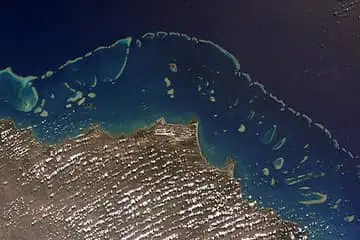
The Great Barrier Reef is the largest coral reef system in the world. It lies in the Coral Sea off the coast of Queensland in north-eastern Australia and stretches for more than 2,300 kilometres. It is not one single reef but a chain of about 2,900 separate reefs and 900 islands, covering roughly 344,000 square kilometres, an area bigger than many countries.
See it on the 3D globe →At a glance
- Country
- Australia
- Location
- Queensland, Australia
Quick answers
Where is Great Barrier Reef?
Great Barrier Reef is in Queensland, Australia.
The world's largest coral reef system, stretching over 2,300 km and visible from space.
The reef was built by billions of tiny animals called coral polyps, which make hard skeletons of limestone. Over thousands of years those skeletons piled up into the biggest structure on Earth made by living things, large enough to be seen from space. It was named a UNESCO World Heritage Site in 1981, and it has long been an important part of the cultures of Aboriginal and Torres Strait Islander peoples.
Who lives on the reef
The reef is one of the busiest homes in the ocean. More than 1,500 kinds of fish live there, including the bright orange clownfish. About 400 kinds of hard and soft coral grow on it, along with around 500 kinds of seaweed. Six kinds of sea turtle come to the reef to breed, large groups of dugongs (gentle sea cows) graze on its seagrass beds, and 30 kinds of whales and dolphins have been seen in its waters, including humpback whales.
How coral makes babies
Most of the reef's corals reproduce in a huge event called mass spawning. On a few nights each year, set off by warmer spring water, the moon and the time of day, many corals release tiny eggs and sperm into the sea at the same moment. On the inner reefs this usually happens in the week after the full moon in October, and on the outer reefs in November and December. The water fills with floating specks that can grow into new corals.
Is the reef in danger?
The reef faces serious problems. When the sea gets too warm, corals push out the tiny algae that live inside them and give them colour, and they turn white. This is called coral bleaching, and if it lasts too long the coral dies. Big bleaching events hit the reef in 2016, 2017 and again in later years. Pollution washing off the land and outbreaks of the coral-eating crown-of-thorns starfish also cause harm. Much of the reef is protected inside the Great Barrier Reef Marine Park, and scientists check its health every year; some years, such as 2022, have shown strong recovery.
Fun facts
- The Great Barrier Reef is the largest structure on Earth built by living things, and you can see it from space.
- It is made of about 2,900 separate reefs and 900 islands.
- Six kinds of sea turtle come to the reef to lay their eggs.
- Captain James Cook's ship Endeavour ran aground on the reef in 1770 and took seven weeks to repair.
On the globe
The model marks the reef in the sea off Queensland, Australia. Zoom in to find it lying along the coast in the Coral Sea, between the shore and the open ocean.
Nearby on the globe

Sources
- Read more on Wikipedia
- Great Barrier Reef — Wikipedia
- 그레이트배리어리프 — 위키백과
- What is the largest living structure on Earth? — NOAA Ocean Service
Updated: 2026-10-13