
Joya de Cerén
호야 데 세렌
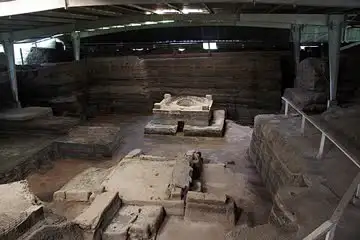
Joya de Cerén is an archaeological site in La Libertad Department, El Salvador, about 36 km northwest of San Salvador. It holds the remains of a Maya farming village that was buried under volcanic ash around AD 600. Because the ash preserved so much, it is often called the "Pompeii of the Americas".
See it on the 3D globe →At a glance
- Country
- El Salvador
- Location
- La Libertad, El Salvador
- Built
- c. 600
- Type
- Ancient site
Quick answers
Where is Joya de Cerén?
Joya de Cerén is in La Libertad, El Salvador.
A Maya farming village preserved under volcanic ash, nicknamed the 'Pompeii of the Americas'.
The village was found in 1976, and UNESCO added it to the World Heritage List in 1993. It is special because it shows how ordinary farmers lived, not kings or priests. The site was lived in from about AD 200 to AD 600. Archaeologists found everyday objects in the places where people left them.
The day the volcano erupted
The Loma Caldera volcano erupted and covered the village in a layer of ash 4 to 8 meters thick within a few hours. Around 200 people probably lived there. The ash was fairly cool, which helped protect things like houses, tools and plants.
Clues such as tools put away, fires lit in hearths and sleeping mats not yet rolled out suggest people left in the early evening. No human remains have been found, so the villagers seem to have escaped.
What the village taught us
Archaeologists found stored beans, ripe maize and other food, plus the remains of a manioc field, the earliest known evidence of manioc farming at an archaeological site in the New World. Crops such as guava, agave and cacao were also grown.
The houses had walls of wattle and daub, which means sticks covered with clay, and adobe columns. Cracks in the walls suggest a small earthquake came before the eruption, perhaps as a warning.
Fun facts
- It was buried by volcanic ash around AD 600 and found in 1976.
- Scientists think the eruption happened in August or September, judging by the ripe plants.
- The ash layer settled over the houses in only a few hours.
- No bodies have been found, so people likely got away.
On the globe
The model shows a Maya village buried under volcanic ash.
Nearby on the globe

Sources
Updated: 2026-10-14